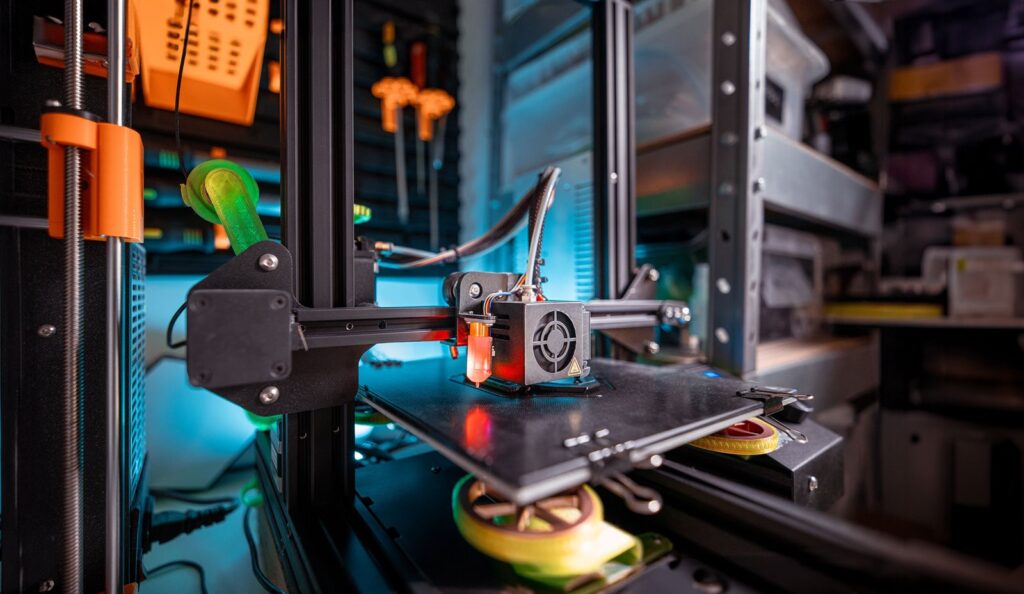
The additive manufacturing market is still growing, but it is no longer a simple hardware-boom story. Wohlers Associates, powered by ASTM International, reported that global additive manufacturing revenue reached USD 24.2 billion in 2025, up 10.9% year over year. That is a modest improvement from the 9.1% growth reported for 2024, but still far below the older double-digit expansion rates that made the category feel like a pure growth market.
The useful signal is not “3D printing is back.” The useful signal is that the market is becoming more production-oriented. Customers care more about throughput, utilization, repeatability, uptime, serviceability, and measurable production outcomes than about buying the newest printer.
For power analog IC suppliers, this matters because the opportunity is not evenly distributed across all 3D printers. A desktop filament printer, a resin printer, a material jetting machine, a binder jetting platform, and a metal powder-bed system create very different semiconductor sockets.
The common mistake is to say: “3D printing is growing, so HV amplifiers and gate drivers should grow with it.”
The better question is:
Which print physics creates a repeatable analog IC socket that is actually open for design-in?
The Common Misunderstanding
A 3D printer is not one electronics architecture. Low-cost FDM is mostly a motion, heater, sensor, fan, and power-supply problem; material jetting and binder jetting are printhead waveform problems; EHD/EFD jetting can be a high-voltage pulse problem; metal AM is usually a laser, motion, thermal, safety, and power-conversion problem.
So the semiconductor question should not start with the printer category. It should start with the subsystem that controls the physical output.
The Field Reality
The strongest direct link between 3D printing and high-voltage analog ICs is not the hobby printer. It is the printhead.
Microchip’s printer-driver portfolio is useful evidence that HV piezo-driver electronics exist for industrial, 3D, textile, ceramic, and related printing applications. Apex Microtechnology’s MP206 example is also useful because it shows a high-current amplifier positioned for capacitive loads such as piezo inkjet printheads.
But those IC vendor pages are not market proof. They prove that the electronics problem exists; they do not prove design-win volume in 3D printing specifically.
The stronger customer-side signal is from the printhead and printer architecture side:
- Stratasys describes PolyJet as a material-jetting process using inkjet heads and UV curing.
- Xaar positions material jetting and binder jetting as two front-runner processes in inkjet 3D printing, and offers printheads, ink supply systems, and drive electronics for OEM integration.
- Ricoh describes industrial inkjet printheads for 3D printing and highlights heated printhead operation for higher-viscosity inks.
- Kyocera’s 2026 high-viscosity industrial printhead announcement mentions advanced manufacturing and 3D printing applications, over 1,500 nozzles, and a proprietary piezo actuator structure.
That still does not tell us the socket size for a new IC supplier. It tells us where to look: jetting architectures where waveform quality, channel density, fluid behavior, temperature, and uptime affect output quality.
Where HV Amplifiers Fit
High-voltage amplifiers and piezo drivers are most relevant when the printer uses controlled droplet ejection or field-driven deposition.
| Printer Architecture | HV Amplifier / Piezo Driver Relevance | Why It Matters |
|---|---|---|
| Desktop FDM | Low | Mostly motion, heaters, fans, and low-voltage control. Brutally cost-sensitive. |
| Industrial high-temperature FDM | Low to medium | More thermal and power-control demand, but not usually piezo-waveform driven. |
| SLA / DLP resin | Low | Optical power and motion matter more than HV piezo drive. |
| Material jetting | High | Piezo waveform quality can influence droplet control, print quality, and uptime. |
| Binder jetting | High | Printhead actuation, channel density, and binder stability matter. |
| EHD / EFD jet printing | High but specialized | High-voltage pulse generation can be part of the deposition physics. |
| Metal AM | Low direct fit | Power opportunity is usually lasers, motion, and conversion, not piezo printheads. |
A physics reference can support why waveform quality matters. Inkjet-based 3D printing research describes droplet formation and driving waveform design as important to stable droplet generation. That is not a market-size proof; it is a reminder that the nozzle can be an analog-control problem.
Where HV Gate Drivers Fit
Gate drivers are relevant, but usually less directly than HV piezo drivers.
In many printers, gate-driver demand appears through subsystems:
- stepper and servo motor stages
- heater-bed and chamber thermal control
- UV LED or laser power stages
- DC/DC and offline power conversion
- pumps, fans, blowers, and material-handling motors
- safety interlocks and high-current switching
For example, Trinamic’s TMC2160 is a high-power stepper driver for 8 V to 60 V systems with external MOSFET stages up to 20 A per coil. NXP’s GD3000 is a gate-driver IC for three-phase motor-drive applications, providing three half-bridge drivers for N-channel MOSFETs.
These are not “3D printing-only” ICs. That is the point. For HV gate-driver suppliers, the 3D printer opportunity is usually an industrial equipment opportunity, not a special standalone 3D printer category.
The Socket-Size Question
A business-development manager should not stop at “the printer uses piezo.” The next question is socket size.
A printhead can contain hundreds or more than 1,500 nozzles, but that does not mean a new external IC supplier gets one clean channel per nozzle. The driver architecture may be inside the printhead module, multiplexed, proprietary, paired with a specific waveform board, or controlled by an established printhead ecosystem.
Before estimating opportunity size, ask for:
- number of printheads per machine
- nozzles or addressable channels per printhead
- drive voltage range
- peak and average current requirement
- slew-rate and waveform-shape requirement
- pulse repetition rate and duty cycle
- whether the driver board is owned by the printer OEM, printhead supplier, or controller-board supplier
- whether the platform is already locked or still in redesign/NPI
If the team cannot answer these questions, they probably do not control the IC socket.
Vendor Claim vs. Factory Reality
| Vendor Claim | What To Verify In Reality |
|---|---|
| “Our printer uses advanced material jetting.” | Which printhead supplier is used, and is the driver architecture open? With Xaar/Ricoh/Kyocera/Stratasys-class printhead ecosystems, the printhead module may lock much of the waveform and drive architecture. |
| “We need better waveform performance.” | Ask for voltage range, slew rate, pulse width, repetition rate, load capacitance, and waveform capture at the printhead connector. If they only have firmware screenshots, the analog socket may sit elsewhere. |
| “We are moving from prototype to production.” | Ask whether nozzle clogging, calibration drift, printhead replacement, yield loss, and service logs are tracked quantitatively. Production pain should show up in data. |
| “We want local IC supply.” | Confirm whether the redesign window is open. A current printer platform may be locked for 12-24 months or longer; the real target may be the next controller-board or printhead-driver revision. |
| “Cost-down is the priority.” | Identify which socket can be costed down without damaging droplet stability, EMI, thermal margin, calibration time, or service failure rate. |
This is where overseas analog IC suppliers often lose time. They chase the printer brand, but the design decision may sit with the controller-board vendor, printhead module supplier, motion-control supplier, or contract manufacturer.
Practical Decision Table For IC Suppliers
| If Your Product Is… | Best 3D Printing Target | Weak Target | Testable First Question |
|---|---|---|---|
| HV amplifier | Material jetting, binder jetting, piezo printhead modules | Low-cost FDM | Ask for printhead load capacitance, voltage range, waveform edge-rate, and measured waveform at the nozzle-board connector. |
| HV piezo driver array | Printhead electronics, industrial/ceramic/textile/3D jetting | General printer control boards | Ask who owns the driver board and whether channel count is increasing in the next platform revision. |
| Half-bridge gate driver | Motion, heater, laser/UV, pump/fan, power conversion modules | Printer categories with fully integrated commodity drivers | Ask whether there is a discrete MOSFET/IGBT/GaN stage and what failure mode currently drives service cost. |
| Stepper/motor driver | FDM axes, industrial motion, powder handling, recoaters | Pure printhead modules | Ask for motor voltage/current, stall detection needs, acoustic/noise target, thermal limit, and axis duty cycle. |
| Precision op amp / current sense | Temperature control, calibration, actuator feedback, power monitoring | Very low-end hobby printers | Ask whether better measurement reduces downtime, scrap, calibration time, or service calls. |
What To Check Before You Treat 3D Printing As A Target Market
Before investing sales or FAE resources, ask five questions:
- Which printer physics creates the socket?
FDM, resin, material jetting, binder jetting, EHD, and metal AM are different electronics markets. - Who owns the electronics architecture?
The printer brand may not control the printhead driver, motion board, or power module. - Is the socket performance-sensitive or cost-only?
HV waveform quality and channel density are defensible. Commodity heater switching is harder to defend. - Can the supplier support local debugging?
Waveform, EMI, heat, reliability, and production-test issues often need local engineering response. - Is the design-in repeatable across models?
One custom machine is not a market. A platform architecture across several printers may be.
ChinaSemiOps Interpretation
For a China-facing analog or power IC supplier, the first discovery call should not be about the total 3D printing market. It should be about control of the subsystem.
The useful questions are practical:
- Is this a printer OEM, printhead module company, controller-board supplier, or contract manufacturer?
- Is the current platform locked, or is the next revision still open?
- Does the design-in require waveform support, EMI debugging, thermal validation, or production-test correlation in China?
- Is the pain visible in service cost, yield loss, printhead replacement, calibration time, or failed customer acceptance tests?
A component vendor sends a datasheet and waits for a quote request. A useful application-side supplier helps the customer capture the waveform, isolate the failing subsystem, compare the cost of failure against the BOM delta, and prove the fix on the next board spin.
That is the difference that matters in this market.
Closing
3D printing is a real and maturing market. But for power analog IC suppliers, the attractive opportunity is not the headline market size. It is the specific subsystem where analog precision, high-voltage drive, and power-stage reliability shape the printer’s output.
For HV amplifiers, look close to piezo and field-driven printheads. For HV gate drivers, look at industrial power, motion, heater, laser, and conversion subsystems. For both, the winning question is the same:
Does this IC make the printer more repeatable in production, or is it just another part on a cost-down BOM?
If the answer is production repeatability, the opportunity is worth investigating.
Sources
- Wohlers Associates / ASTM, Wohlers Report 2026 press release: https://wohlersassociates.com/press-releases/new-wohlers-report-2026-values-additive-manufacturing-market-at-24-2b/
- ASTM, Wohlers Report 2025 press release: https://www.astm.org/news/press-releases/wohlers-report-2025
- ASTM Market Intelligence Portfolio: https://www.astm.org/standards-and-solutions/market-insights-and-innovation/market-intelligence-portfolio
- Stratasys PolyJet technology overview: https://www.stratasys.com/en/guide-to-3d-printing/technologies-and-materials/polyjet-technology/
- Xaar 3D printing application page: https://www.xaar.com/applications/3d-printing/
- Ricoh industrial inkjet printheads for 3D printing: https://www.ricoh.com/products/industrial-inkjet-printheads/application-3d
- Kyocera high-viscosity industrial printhead announcement: https://americas.kyocera.com/news/2026/01/27081813.html
- Microchip high-voltage piezoelectric drivers for printers: https://www.microchip.com/en-us/products/interface-and-connectivity/dc-dc-high-voltage-interface-drivers-amplifiers-arrays/mems-piezoelectric-drive/printers
- Apex MP206 / DigiKey printhead-driver page: https://www.digikey.jp/en/product-highlight/a/apex-microtechnology/mp206-2-channel-power-amplifier-print-head-driver
- MDPI Sensors paper on piezoelectric printing waveform design: https://www.mdpi.com/1424-8220/22/3/935
- IntechOpen chapter on electric-field-driven jet 3D printing: https://www.intechopen.com/chapters/61745
- Trinamic TMC2160 / DigiKey high-power stepper driver: https://www.digikey.com.au/en/product-highlight/t/trinamic/tmc2160-ta-high-power-stepper-driver-ic
- NXP GD3000 gate driver: https://www.nxp.com/products/GD3000