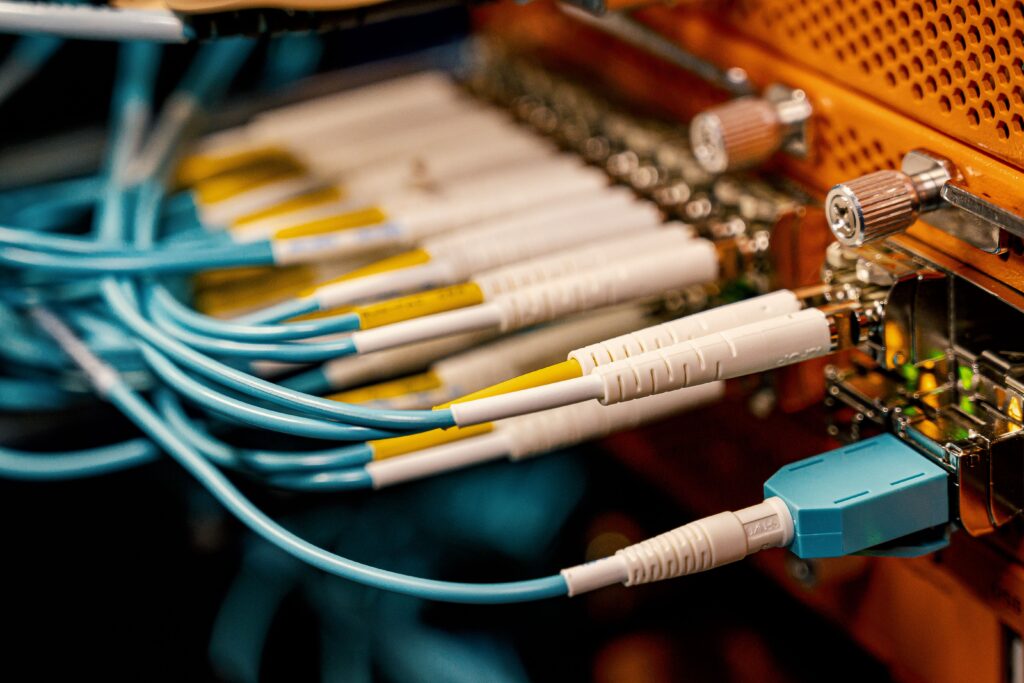
Co-packaged optics has become the most over-promised line item in every AI data center roadmap presentation. Vendors describe it as already shipping, already solving the power crisis, already the default architecture for next-generation AI clusters. Some of that is true. Most of it describes a 2028-2030 reality being presented as a 2026 one.
The underlying problem CPO addresses is not in dispute. AI training clusters move enormous east-west traffic between tens of thousands of GPUs, and at the current switch-ASIC generation, the electrical path from chip to front-panel optical module has become a genuine bottleneck — in both signal integrity and power. Co-packaging the optical engine onto the same substrate as the switch ASIC shortens that path from tens of centimetres to a few millimetres, cutting the power needed to drive it and the loss the signal has to fight through. The architecture is sound. The question that matters for anyone supplying into this stack — especially in power management and analog ICs — is which parts of it are real today, and which parts are still a roadmap slide.
The Common Misunderstanding
The first misunderstanding is that co-packaged optics is already a shipping, volume technology. It is shipping — Broadcom’s Bailly, an 8×6.4T optical-engine switch built with Tomahawk 5, has been customer-delivered since 2024, with reliability data reported from Meta’s own lab testing. But the next generation up — Broadcom’s 102.4T Tomahawk 6 “Davisson” platform, and NVIDIA’s Quantum-X and Spectrum-X Photonics switches — are sampling to early-access customers on a 2025-2026 commercialization timeline, not shipping at volume. “Announced” and “in early customer hands” and “in volume production” are three different stages, and vendor language tends to blur all three into one confident present tense.
The second misunderstanding is that there is a single “CPO market size” number. There is not. Yole’s most recent dedicated CPO report puts the 2024 market at $46 million, growing to $8.1 billion by 2030. A separate, earlier Yole-sourced conference presentation puts 2030 at $2.6 billion — a different forecast, not the same number repeated. Stellar Market Research puts the 2024 market at $200 million — four times Yole’s figure, in the same year. These are not measurement errors. They are different definitions of what counts as “the CPO market,” built on different report vintages. Anyone repeating a single CPO market-size figure as settled fact is, knowingly or not, picking one definition out of several and presenting it as the only one.
What Co-Packaged Optics Actually Changes
In a pluggable architecture, the switch ASIC sits on the main board and electrical signals travel 25 to 30 centimetres through package escape, board traces, and connectors before reaching a front-panel optical module, which then converts them to light. That long electrical run is lossy enough that it requires power-hungry DSPs and retimers to clean up the signal. In a co-packaged architecture, the optical engine sits millimetres from the ASIC on the same package or substrate, and fiber is routed directly off the package rather than to a front-panel cage.
The benefit shows up in two places: power and density. Shortening the electrical channel is commonly described as cutting system-level I/O power by more than 30%, and it allows roughly double the bandwidth in the same faceplate footprint — the shift from 51.2T to 102.4T switch generations tracks with this. What does not change is optical reach: CPO is not a longer-distance technology than pluggables. The innovation is entirely in the electrical and packaging side of the link.
What this buys the system architect comes at a real cost. Pluggable modules are field-replaceable, standardized, and can be swapped by a technician in seconds. A co-packaged optical engine is part of the switch package. If a laser degrades or a fiber attach point fails, the repair path is far more complex than unplugging a module — which is precisely why thermal co-design, laser reliability, and power delivery to the optical engine matter so much more in this architecture than in a pluggable one.
The IC Stack a CPO System Actually Needs
A co-packaged optical engine integrates several distinct IC functions that used to live inside a pluggable module: a laser driver, a transimpedance amplifier (TIA), and — in some architectures — an optical DSP or retimer. The laser driver and TIA are production-deployed technologies in the pluggable world; CPO-specific variants of both are in pilot and pre-production today.
The more interesting shift is what happens to the DSP. Because CPO’s electrical channel is so short, some architectures eliminate the dedicated optical DSP entirely — an approach known as linear-drive or linear pluggable optics (LPO) — and shift the signal-conditioning work onto the host ASIC’s own SerDes plus the laser driver and TIA’s analog front end. This is not a universal replacement; retimed and partially-retimed architectures continue to coexist with linear-drive ones, and LPO is expected to remain a meaningful but not dominant share of the market even at the 200G-per-lane generation. What it does mean is that analog front-end quality becomes a bigger differentiator exactly where DSP silicon disappears.
The category that gets the least attention in vendor marketing, and the most attention from anyone who has actually had to design one of these systems, is power management. Co-locating an optical engine with a switch ASIC that can draw well over 800 watts creates a power-delivery and thermal problem with no equivalent in a pluggable system. The optical engine needs several independently clean rails — a high-precision, low-noise rail for laser bias, separate rails for driver and TIA logic, and a monitoring/control rail — which pushes toward multi-output point-of-load converters rather than a single supply. The ASIC’s heat, which can exceed 100°C locally, directly affects laser wavelength stability and output power, so the power IC has to operate reliably at high ambient temperature and, in some designs, manage thermal-aware sequencing to protect the laser. When an external laser source is used instead of an on-engine laser, industry specifications place responsibility for optical power control, safety interlocks, and fault sequencing on the host board controller — pushing power and control complexity outward, not eliminating it.
This is the part of the CPO story that rarely makes it into a roadmap slide: the PMIC here is not a generic power supply bolted onto an optics module. It is part of the reliability chain. A power failure at the optical engine can take down the entire switch package, not just one port.
Where the Players Actually Stand
On the systems side, Broadcom is furthest along: Bailly is customer-delivered and production-enabled, and the company’s next-generation TH6-Davisson 102.4T platform is sampling to early-access customers. NVIDIA has announced Quantum-X Photonics for InfiniBand and Spectrum-X Photonics for Ethernet, targeting 2025-2026 commercialization — real announced products, not yet volume-deployed. TSMC’s COUPE is best understood as an enabling foundry and advanced-packaging platform that other companies’ CPO designs run on, rather than a merchant CPO product in its own right. Marvell supplies both ends of the spectrum at once: its discrete DSP, TIA, driver, and switch-ASIC portfolio is production-shipping, while its 1.6T silicon-photonics light engine is in pilot and sampling — two very different maturity levels inside one supplier’s name, and worth separating when evaluating the company.
The China-domestic picture is harder to pin down with confidence, and that difficulty is itself informative: most named activity is research and pilot stage, not shipping product. The clearest two data points are HG Genuine, which has disclosed — through its own investor communications as well as trade press — a 3.2 Tb/s liquid-cooled CPO optical engine moving into small-batch trial production alongside a parallel NPO product with in-hand 2026 orders, and Accelink, whose externally sourced CPO laser module line was shown publicly at CIOE 2025 and is reportedly engaged with major domestic cloud providers, though that specific customer-engagement detail rests on a single trade report and should be treated as directional rather than confirmed. Both companies are real, both are at pilot/pre-production stage, and neither has published evidence of volume CPO shipment yet. Chinese policy guidance for 2026-2028 explicitly calls out co-packaged optoelectronic devices as an R&D and validation priority — a concrete, named policy hook, distinct from the more general self-sufficiency language that surrounds most semiconductor sectors.
Where Power Management Actually Fits the Opportunity
The thesis that domestic AI-compute servers and CPO are the two hottest application areas right now, and that both need better power management to support them, holds up — but the two halves of that claim rest on different kinds of evidence, and it matters which half a supplier is actually betting on.
The AI-server side has the stronger near-term case. Current-generation accelerators carry thermal design power in the 700-watt-plus range, with next-generation parts trending toward 1 to 1.5 kilowatts, and an 8-GPU board can draw well over 10 kilowatts. Delivering that at high efficiency with tight transient response under extreme load steps is a well-evidenced, named-product opportunity: Infineon, Texas Instruments, and Renesas all have current multiphase controllers and power stages on the market for exactly this load, and several domestic Chinese suppliers — including Chipown, JoulWatt, BPS, Silergy, SG Micro, ChangGong Micro, and Aura — have real, shipping multiphase and DrMOS products targeting the same segment. This is the most competitive tier in the stack, but it is also the one with the clearest proof that the market exists today.
The CPO-specific power opportunity — a PMIC purpose-built for the optical engine’s multi-rail, thermally-sensitive requirements — is the more speculative half of the thesis. The technical need is real and well understood, but no source in this research turned up a named design win, a named customer, or a revenue figure tied specifically to a CPO optical-engine PMIC. What exists is informed industry logic about where the requirement will land, not yet evidence that a market has opened. That makes it a believable, high-growth-potential opportunity gated by reference-design access with the switch and ASIC vendors and by long qualification cycles — not, today, a demonstrated one. A supplier evaluating this space should treat the AI-server VRM opportunity as the one to win now, and the CPO-engine PMIC opportunity as the one to build relationships and design-in access for ahead of a market that has not yet materialized in named form.
Where ChinaSemiOps Creates Practical Value
The gap between a roadmap slide and a qualifiable design win is exactly where most CPO-adjacent business development goes wrong, and it is the gap ChinaSemiOps is positioned to close.
- Separate vendor-announced CPO products from volume-shipping ones, and track which generation (51.2T vs. 102.4T-class) is actually customer-deployed versus early-access sampling at any given time
- Reconcile or correctly caveat conflicting market-size and timeline figures from Yole, IDTechEx, Stellar Market Research, and LightCounting rather than repeating whichever number was most recently seen
- Identify and validate China-domestic CPO and optical-component suppliers, including which claims are corroborated by more than one source and which remain single-source and should be treated cautiously
- Map the specific power-IC requirements of optical-engine co-location — multi-rail PoL, thermal-aware sequencing, laser-bias precision — against a supplier’s actual product portfolio, rather than against generic AI-server power specifications
- Distinguish the AI-server VRM opportunity, which is evidenced and competitive today, from the CPO-engine PMIC opportunity, which is real but design-win-driven and not yet proven in the market
Vendor Claim Versus Field Reality
- “Our CPO switch is already in high-volume production.” Verify which generation. Production-enabled, customer-delivered status (Broadcom Bailly, 51.2T) is real today. The next generation up (102.4T-class platforms from Broadcom and NVIDIA) is sampling to early-access customers on a 2025-2026 timeline — a materially earlier stage than “high-volume production.”
- “The CPO market will be worth $X billion by 2030.” Verify which report and which scope. Published forecasts for the same year diverge by 3 to 4 times depending on whether pluggables, LPO, or adjacent transceiver categories are folded into the definition. Ask for the report’s exact market definition before citing the number.
- “CPO cuts electrical loss from 22 dB to 4 dB” or “removes 50% of switch power.” These are vendor-published comparisons (NVIDIA and Broadcom, respectively), directionally consistent with the architecture’s real benefits, but not independently normalized third-party benchmarks. Treat them as the vendor’s own framing of its own product.
- “We are the industry’s first 102.4T CPO platform.” This is marketing language from the company making the claim, not an independently verified market fact. It may well be accurate, but it should be cited as a vendor claim, not repeated as settled fact.
- “[Domestic supplier] is shipping CPO optical engines at volume.” Verify against the supplier’s own investor disclosures, not trade press alone. Several real China-domestic CPO efforts exist at credible pilot or small-batch trial stage; none of the sources reviewed for this article show confirmed volume shipment of a CPO optical engine from a Chinese supplier as of this writing.
Closing
Co-packaged optics is not vaporware, and the power management problem it creates is not a side issue — it is a structural part of why CPO is hard to build at all. But the technology is earlier in its deployment curve than most vendor messaging implies, and the market-size numbers attached to it are not as settled as a single cited figure suggests.
For a power management or analog IC supplier, the practical opportunity today is the AI-server VRM and multiphase-power market, which is real, evidenced, and intensely competitive. The CPO optical-engine PMIC opportunity is the one worth building toward — establishing the technical relationships and design-in access now — rather than the one with a proven revenue line to point to yet. Knowing which stage each opportunity is actually at is the difference between a credible roadmap conversation and a pitch deck.
Sources
- OIF Co-Packaging framework: https://www.oiforum.com/wp-content/uploads/OIF-Co-Packaging-FD-01.0.pdf
- OIF external laser source management specification: https://www.oiforum.com/wp-content/uploads/OIF-MGT-Co-Packaging-ELSFP-01.0-1.pdf
- NVIDIA, scaling AI factories with co-packaged optics: https://developer.nvidia.com/blog/scaling-ai-factories-with-co-packaged-optics-for-better-power-efficiency/
- NVIDIA Spectrum-X / Quantum-X Photonics announcement: https://investor.nvidia.com/news/press-release-details/2025/NVIDIA-Announces-Spectrum-X-Photonics-Co-Packaged-Optics-Networking-Switches-to-Scale-AI-Factories-to-Millions-of-GPUs/default.aspx
- Broadcom Bailly 51.2T co-packaged optics: https://investors.broadcom.com/news-releases/news-release-details/broadcom-delivers-industrys-first-512-tbps-co-packaged-optics
- Broadcom Tomahawk 6 “Davisson” 102.4T announcement: https://investors.broadcom.com/news-releases/news-release-details/broadcom-announces-tomahawkr-6-davisson-industrys-first-1024
- Marvell 1.6T silicon-photonics light engine: https://www.marvell.com/company/newsroom/marvell-demonstrates-silicon-photonics-light-engine-for-low-power-rack-scale-interconnect-in-ai-networks.html
- IEEE Linear Pluggable Optics overview: https://eps.ieee.org/wp-content/uploads/2026/03/Linear-Pluggable-Optics_V2-UPDATED.pdf
- Yole Group, Co-Packaged Optics for Data Centers 2025 report: https://www.yolegroup.com/product/report/co-packaged-optics-2025/
- Stellar Market Research, co-packaged optics market report: https://www.stellarmr.com/report/co-packaged-optics-market/2659
- LightCounting, January 2026 Optics for AI Clusters newsletter: https://www.lightcounting.com/newsletter/en/january-2026-optics-for-ai-clusters-366
- IDTechEx, transforming interconnects in AI systems: https://www.idtechex.com/en/research-article/transforming-interconnects-in-ai-systems-co-packaged-optics-role/31787
- NVIDIA DGX GB200 NVL72 hardware/power guide: https://docs.nvidia.com/dgx/dgxgb200-user-guide/hardware.html
- Infineon, AI data center power solutions: https://www.infineon.com/applications/ai-data-center/data-center-power-solutions/server-rack-power-management
- Texas Instruments, power management for scalable AI infrastructure: https://www.ti.com/about-ti/newsroom/news-releases/2025/tis-new-power-management-solutions-enable-scalable-ai-infrastructures.html
- Renesas multiphase DC-DC switching controllers: https://www.renesas.com/en/products/power-management/multi-phase-power/multiphase-dcdc-switching-controllers