AI infrastructure is usually described as a GPU story. That is true, but incomplete. As accelerator racks move from tens of kilowatts toward hundreds of kilowatts and, in some roadmaps, megawatt-scale systems, the power stack stops being background plumbing. It becomes one of the constraints that decides what can be built.
That shift matters for semiconductor companies outside the GPU lane. The move from today’s 48 V and 54 V rack ecosystems toward higher-voltage DC distribution, including 800 VDC architectures, does not only create demand for SiC and GaN power switches. It reopens system-level problems in analog, mixed-signal, isolation, sensing, protection, gate drive, power-conversion control, and telemetry.
The opportunity is not automatic. It depends on topology, qualification, safety rules, and who owns each power boundary. But the direction is clear enough to deserve attention.
48 V Is The Baseline, Not The Past
The near-term world still starts with 48 V and 54 V rack power. Open Compute Project Open Rack V3 material defines IT gear interfaces to a 48 V busbar, including a 46 V to 52 V DC operating range for the input connector. That ecosystem is practical, standardized, and familiar.
The issue is scale. At fixed power, lower voltage means higher current. Higher current increases busbar mass, connector stress, distribution loss, heat, and mechanical complexity. The Oak Ridge / ORNL review of next-generation AI data-center power architectures states that AI workloads are driving increased power demand, current transients, and thermal stress, exposing limits in traditional 48 V rack architectures and low-voltage AC distribution.
So the story is not “48 V failed.” The story is that AI rack power is stretching the architecture beyond the comfort zone it was designed for.
For the present 48/54 V board boundary, see how integrated eFuses compare with external-MOSFET hot-swap controllers.
Why 800 VDC Entered The Conversation
NVIDIA’s 800 VDC architecture material makes the argument bluntly: future AI servers will need more power than today’s 54 VDC architectures can support, and 800 VDC can reduce current, copper use, cable bulk, conversion stages, and space. NVIDIA’s technical blog also frames 800 VDC around AI factory scale, where conversion equipment and copper can crowd out compute.
That does not mean 800 VDC is already universal. Vertiv’s public 800 VDC platform-readiness announcement points to a portfolio planned for second-half 2026 release aligned with 2027 NVIDIA Rubin Ultra support. The academic solid-state-transformer work is still simulation and validation-workflow evidence. The right wording is: 800 VDC is a serious emerging architecture, not a settled universal standard.
That distinction is important because the semiconductor opportunity depends on timing. Near-term business is still built around 48 V and 54 V systems, sidecar power, high-density DC/DC conversion, and incremental data-center power upgrades. Longer-term planning needs to watch 800 VDC facility and rack distribution, medium-voltage-to-DC conversion, and DC protection.
For the emerging rack boundary, see why 800 VDC hot swap becomes an analog control-plane problem.
The Device Story Is Only Half The Story
Wide-bandgap devices get the headlines for good reasons.
Toshiba’s June 2026 data-center inverter work points to 1200 V-class SiC power modules for high-frequency inverters and UPS systems. Siemens and Infineon are applying SiC power modules to solid-state circuit breakers for data centers, factories, and battery storage. ROHM’s TSC3PAK package shows how SiC packaging is being adapted for automated assembly and top-side cooling, including server-PSU-adjacent applications.
But a data-center power architecture is not made of switches alone. Every higher-voltage conversion stage needs drivers, isolation, sensing, bias, protection, startup control, fault handling, thermal monitoring, and communication. Every change in rack voltage and service boundary creates new questions:
- How is an 800 V bus precharged, isolated, monitored, and safely disconnected?
- How fast must a protection IC detect and respond to a DC fault?
- What common-mode transient immunity is required for the gate driver and isolator?
- Where does regulation happen: sidecar, rack, tray, board, or package-adjacent module?
- How does the converter ride through GPU load transients without oversizing the whole power chain?
- What telemetry does the facility operator need to service a high-voltage rack safely?
Those are custom analog and power IC questions.
Where The Custom IC Openings Appear
The OCP power-architecture paper describes 800 V to 48 V and 800 V to 12 V conversion approaches using high-frequency LLC/DCX and matrix-transformer structures. It also notes that the architecture may create opportunities for optimized digital power controllers dedicated to 800 VDC AI data-center systems.
That is the right frame. The custom IC opportunity is not “make an 800 V chip” in the abstract. It is to own a hard control or protection problem at a specific boundary.
For the adjacent medium-voltage conversion layer, see where solid-state transformers create support-semiconductor opportunities.
Possible openings, as design-space inferences rather than confirmed sockets, include:
- isolated SiC/GaN gate drivers with high CMTI and fast protection paths;
- digital power controllers for high-ratio 800 V to 48 V or 800 V to 12 V conversion;
- isolated current and voltage sensing for rack and sidecar converters;
- hot-swap, precharge, inrush, and safe-disconnect controllers for high-voltage DC buses;
- solid-state circuit-breaker control and fault-detection ICs;
- telemetry and health-monitoring analog front ends;
- auxiliary bias and isolated power for high-side domains;
- BCD/SOI mixed-signal control ICs that combine high-voltage interfaces with low-voltage logic.
Boundary Map: Where The IC Problem Changes
| Power boundary | Technical problem | Possible IC/control opening | Evidence strength |
|---|---|---|---|
| 48 V / 54 V rack bus | High current, busbar and connector heat, load transients | Sensing, hot-swap, telemetry, transient supervision | Strong for 48 V baseline; inferred for custom IC openings |
| 800 V sidecar or rack input | Safe precharge, isolation, disconnect, service access | High-voltage supervisors, isolation, precharge and protection ICs | Strong for architecture direction; inferred for exact sockets |
| 800 V to 48 V / 12 V converter | High-ratio conversion, MHz switching, thermal density | Digital power controller, gate driver, bias, current and voltage sensing | Source-backed for conversion architectures and controller opportunity |
| SSCB / DC protection | Fast DC fault interruption and coordination | Fault detection, gate-drive protection, isolated sensing | Strong for SiC SSCB system relevance; inferred for custom IC demand |
| GPU-adjacent power | Fast load steps and dense conversion near compute | Power telemetry, multiphase control, protection, sequencing | Strong for system pressure; topology-dependent for sockets |
Soitec and ZenSemi’s 300 mm BCD-on-SOI announcement is relevant here as manufacturing context. BCD-on-SOI is positioned for integrating high-voltage power stages and sensitive low-voltage control circuitry with dielectric isolation and reduced latch-up and crosstalk. That does not prove data-center demand by itself, but it shows the process ecosystem is being positioned for exactly the class of integrated power-control problems AI infrastructure is creating.
CPO Adds Serviceability Pressure
Co-packaged optics should not be dragged into this article as a second topic. The point is narrower. As optics move closer to compute, the system becomes less tolerant of casual service assumptions. A recent CPO critique paper argues that packaging, thermal management, standardization, serviceability, and thermal-aware co-design will decide whether CPO scales.
Power has the same character. A high-voltage rack or sidecar power architecture is not just an electrical optimization. It changes what technicians can touch, how modules are replaced, how faults are isolated, and how much intelligence the power system needs to expose.
That is another reason analog and power ICs matter. Sensing, isolation, protection, and telemetry are the pieces that make a high-density power architecture operable, not just efficient.
The Sober Takeaway
AI data centers are not only asking for more watts. They are changing where power conversion lives, how high the distribution voltage can go, how quickly loads move, how cooling and service access work, and how much fault energy must be controlled.
That is why custom analog and power ICs re-enter the conversation.
A practical reading is that the best-positioned teams will not be the ones that simply attach “AI” to a gate driver or PMIC. They will be the teams that can map the power boundary, identify the protection and control bottleneck, prove the device under realistic transients and thermal conditions, and speak the language of data-center serviceability.
48 V is the installed base. 800 VDC is the emerging direction. The design space between them is where the next generation of power IC opportunities will be found.
Sources
- OCP Open Rack V3 IT Gear Design Guide Rev. 02: https://www.opencompute.org/documents/ocp-orv3-it-gear-design-guide-rev-02-june032024-pdf
- OCP Open Rack V3 IT Gear 48 V Input Connector: https://www.opencompute.org/documents/ocp-open-rack-v3-it-gear-input-connector-rev01-6-220929-pdf
- OCP Power Architecture Evolution in Data Centers: https://www.opencompute.org/documents/power-architecture-evolution-in-data-centers-pdf
- NVIDIA 800 VDC architecture page: https://www.nvidia.com/en-us/data-center/technologies/800-vdc-architecture/
- NVIDIA technical blog on 800 V HVDC for AI factories: https://developer.nvidia.com/blog/nvidia-800-v-hvdc-architecture-will-power-the-next-generation-of-ai-factories/
- NVIDIA technical blog on building the 800 VDC ecosystem: https://developer.nvidia.com/blog/building-the-800-vdc-ecosystem-for-efficient-scalable-ai-factories/
- ORNL / Oak Ridge arXiv review, Toward Next-Generation AI Data Centers: https://arxiv.org/abs/2606.25095
- SST-driven 800 VDC simulation paper: https://arxiv.org/abs/2601.16502
- CPO critique paper: https://arxiv.org/abs/2603.21313
- Toshiba SiC module technology for high-frequency data-center inverters: https://toshiba.semicon-storage.com/ap-en/company/news/news-topics/2026/06/sic-power-devices-20260612-1.html
- Siemens / Infineon SiC solid-state circuit-breaker collaboration: https://press.siemens.com/global/en/pressrelease/siemens-and-infineon-leverage-silicon-carbide-technology-advance-electrical-protection
- ROHM TSC3PAK top-side cooling package: https://www.rohm.com/news-detail?defaultGroupId=false&news-title=2026-06-09_news_tsc3pak
- Soitec / ZenSemi 300 mm BCD-on-SOI collaboration: https://www.globenewswire.com/news-release/2026/06/29/3318663/0/en/soitec-and-zensemi-partner-to-scale-300mm-bcd-on-soi-production-for-next-generation-power-electronics.html
- Vertiv / NVIDIA 800 VDC platform-readiness announcement: https://www.vertiv.com/en-us/about/news-and-events/corporate-news/from-vision-to-readiness-vertiv-collaborates-with-nvidia-to-advance-800-vdc-platform-designs-to-power-the-next-generation-of-ai-factories/
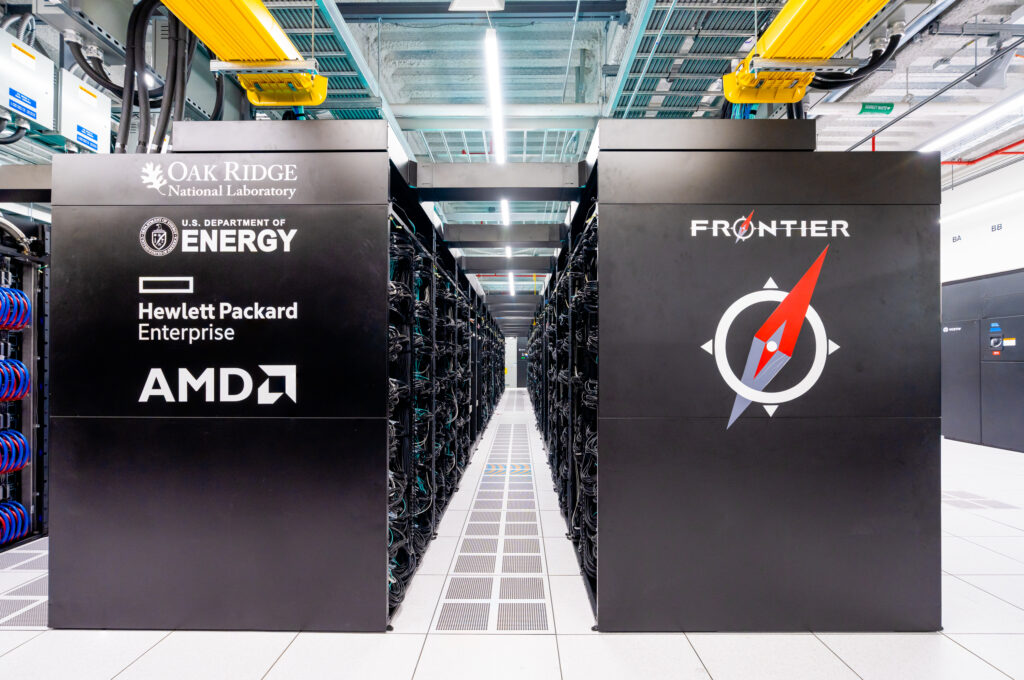
- Featured image: OLCF at ORNL, via Wikimedia Commons, licensed under CC BY 2.0.