The robotics power-stage market just got harder to enter — not because the opportunity disappeared, but because Texas Instruments and EPC have already claimed the high ground.
At ChinaSemiOps we track application-specific analog and power IC opportunities for fabless teams targeting growth markets. The humanoid robot joint looked like a clear gate-driver opportunity six months ago. Revisiting it with GaN gate drivers, GaN half-bridge power stages, and GaN inverter reference designs explicitly in scope changes that picture significantly.
What Changed: GaN Validates the Direction and Crowds the Market
The original thesis — a 100 V smart three-phase MOSFET gate driver optimized for robot joints — was already weak. TI DRV8353, Infineon 6EDL7141, MPS MP6539B, and a dozen other parts already cover that design space. Adding GaN to the analysis does not rescue the MOSFET gate driver thesis. It replaces it with something more interesting and more contested.
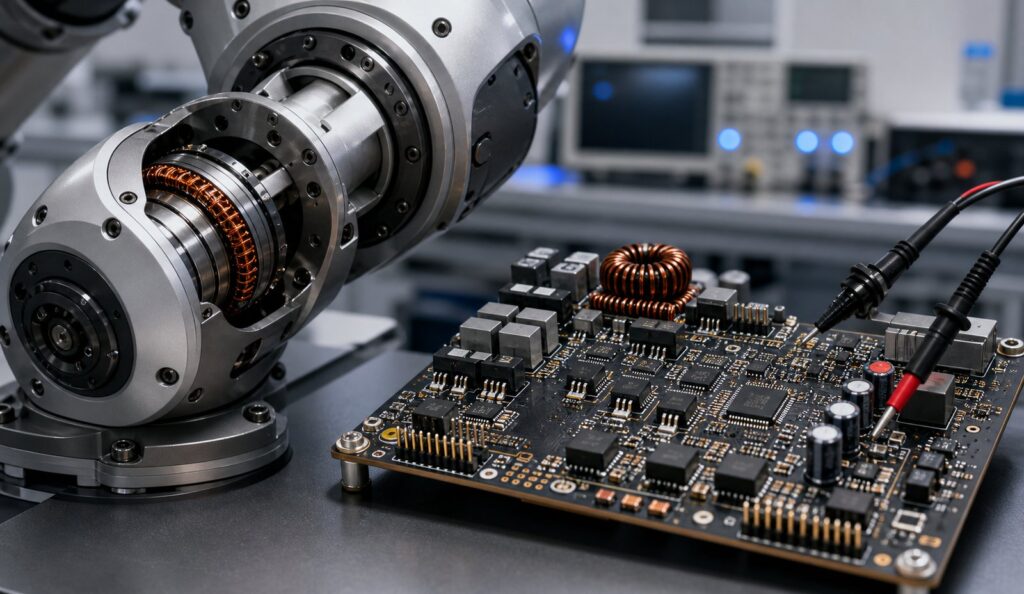
TI now has a GaN motor-driver product category. The preview DRV7167 is a 100 V / 70 A half-bridge GaN motor-driver power stage with integrated eGaN FETs, 500 kHz PWM support, 20 ns propagation delay, slew-rate control, VDS cycle-by-cycle short-circuit protection, and over-temperature reporting. More strategically, TI published TIDA-010979 in March 2026: a 48 V / 1 kW humanoid robot-joint motor-control reference design on a 70 mm diameter PCB. Three DRV7167 half-bridge stages, an AM2612 real-time MCU, industrial Ethernet, encoder interface, and AMC0106 isolated delta-sigma current sensing. This is not a paper claim. It is a complete validated platform aimed directly at the humanoid joint segment.
EPC positions GaN explicitly for robotics and motor drives. EPC23102 is a 100 V / 35 A integrated ePower Stage IC — high-side and low-side eGaN FETs, internal gate driver and level shifter, synchronous bootstrap charging, active gate pull-down, UVLO, false-trigger immunity, 3.5 mm × 5 mm package. EPC’s EPC9176 evaluation board builds a complete 48–80 V three-phase BLDC inverter around EPC23102, with current, voltage, and temperature sensing, protection, and dV/dt tuning below 10 V/ns for joint encoder and communication-line compatibility.
The implication: TI and EPC are not selling components. They are selling validated reference platforms for exactly the humanoid joint segment a new fabless entrant would target.
Application Branches: What Is No-Go
This analysis closes several product directions that might still seem attractive on a first pass.
Generic 100 V smart silicon MOSFET pre-driver: No-go. DRV8353, 6EDL7141, MP6539B, Toshiba TB9083, Allegro A4939, and others already occupy this space. The market is mature.
Standalone GaN half-bridge gate driver: No-go as a standalone thesis. TI LMG1205 (100 V) and LMG1210 (200 V) benchmark this role with 1.5 A source / 3–5 A sink current, integrated bootstrap, split gate outputs, and nanosecond-level propagation and matching performance. A new part would need to offer a robotics-specific function beyond “we can drive GaN fast.”
Generic integrated GaN half-bridge power stage: Conditional. Technically attractive, but a new entrant would compete head-on with DRV7167 and EPC23102 without an established GaN process, package, or reliability base. Not the first product for a fabless analog team entering the market.
650 V GaN IPM: A separate roadmap item. Relevant for future high-voltage servo or appliance targets, not the 48 V humanoid joint first segment.
The Real Opening: A Companion IC
The market analysis converges on a different product hypothesis. Not a gate driver. Not a power stage. A robotics-joint inverter front-end companion IC: an analog and mixed-signal safety, sensing, protection, diagnostics, and regen-coordination IC that works alongside existing silicon MOSFET or GaN power stages.
The candidate role:
- Current sensing that remains accurate under high dV/dt GaN PWM switching — without the BOM cost, board area, and signal-chain latency of isolated delta-sigma modulators like the AMC0106 in TIDA-010979
- Deterministic hardware safe-disable independent of MCU and SPI state — dual hardware paths, default-off behavior during brownout, MCU reset, SPI lockup, or bootstrap loss
- Regen and DC-link fault coordination — hardware bus-OV detection, brake-chopper or BMS handoff, multi-joint braking policy that does not depend on firmware latency
- Field diagnostics — phase-fault counters, VDS stress events, thermal dwell history, bootstrap and gate UVLO events, safe-disable event logs
- Reference layout and test data for compact 48 V / 60 V humanoid joint inverters
The clearest testable claim: a companion IC for 48 V / 60 V GaN half-bridge inverters that reduces current-sensing BOM and latency versus isolated delta-sigma sensing, provides hardware fault and regen and safe-disable behavior independent of firmware, and fits a 70 mm-class robot-joint inverter reference design.
Four Gaps Worth Testing
Current sensing under GaN PWM. The TIDA-010979 design uses isolated delta-sigma current sensing. That architecture is robust but it adds cost, board area, and signal-chain latency. A high-CMRR, fast-recovery, PWM-edge-aware current-sense front end that avoids isolated modulators in 48 V / 60 V joints could reduce BOM and improve torque-loop bandwidth — if the accuracy and noise floor hold up under actual GaN switching transients, not just datasheet CMRR numbers.
Regen and DC-link fault coordination. GaN enables compact inverters with smaller DC-link capacitance. Smaller capacitance means faster bus-voltage rise during joint braking or back-drive events. In a humanoid with multiple joints decelerating simultaneously, the bus transient problem compounds. Hardware bus-OV detection and brake-chopper or BMS coordination that operates independently of the MCU and SPI path could address a failure mode that reference designs do not handle explicitly.
Deterministic safe disable. Most reference designs implement safe-disable through firmware and SPI. A hardware disable path that operates deterministically — with a documented pin-to-gate-off latency, defined safe states under partial power, and an FMEDA-ready parameter skeleton — would reduce the safety documentation burden for robot OEM customers and potentially accelerate qualification.
Compact-joint EMI and thermal behavior. Raw GaN dV/dt at 500 kHz in a 70 mm sealed enclosure can corrupt encoder signals, CAN and Ethernet lines, motor winding insulation, and EMI margins. Programmable slew and dV/dt modes, a layout-proven reference module, and top-side thermal path design for sealed joint housings are collateral assets that TI and EPC partially provide but have not fully solved for all customer configurations.
What Is Not Proven Yet
Each of the four gaps above is a hypothesis, not a confirmed design win. Several common overclaims are worth flagging before anyone builds a business case on them.
GaN does not eliminate dead time. It can reduce reverse-recovery penalties and allow shorter dead time, but real dead time exists and must be characterized. GaN does not make joints acoustically silent — mechanical noise, current ripple, magnetic noise, gears, bearings, and control artifacts remain regardless of switching frequency. Higher PWM frequency does not equal proportionally higher FOC control bandwidth. Smaller DC-link capacitance cannot be claimed without regen and bus-transient analysis specific to the target system. And safe-disable or STO claims cannot be made without the full safety process — the companion IC can provide STO-compatible architecture, not certified STO.
Customer Discovery Is the Gate
Silicon commitment should not happen before customer discovery confirms unresolved pain. The key questions for humanoid joint and cobot actuator electronics teams:
- Are you evaluating TI DRV7167 / TIDA-010979 or EPC23102 / EPC9176 today?
- What current-sensing architecture are you using, and does PWM-edge recovery or dV/dt corruption show up as torque ripple or unstable FOC?
- What happens to the DC bus when multiple joints decelerate together?
- What is your hardware safe-disable path, and how many external components does it require?
- What would justify changing away from TI or EPC or an existing MOSFET driver?
If TI, EPC, and the existing MOSFET driver field already solve these problems well enough for target customers, the right answer is no-go on silicon. The companion IC thesis only holds if bench data and customer discovery confirm a measurable gap.
Recommended Direction
The revised verdict is: research go, silicon no-go until customer discovery and bench proof confirm unresolved pain that TI, EPC, and MOSFET incumbents do not solve.
The next 90 days of technical work — a competitive database, a gate-drive sizing calculator, a robot-joint stress matrix, a current-sense FOC error model, a regen DC-link sizing model, and an STO architecture template — build the evidence base. Customer discovery interviews validate or invalidate the companion IC pain hypothesis before any silicon decision.
The humanoid joint market is validated and contested. The question is whether the companion IC wedge is real. That answer comes from customers and a bench, not from a research report.
Primary sources: TI DRV7167 product page, TI TIDA-010979 reference design, EPC23102 and EPC9176 product pages, and TI LMG1205 and LMG1210 datasheets.