AI infrastructure is no longer constrained by compute alone. A cluster can own enormous GPU capacity and still waste it if the network cannot move data fast enough.
That is pushing optics deeper into the system, but copper is not disappearing. The right interconnect depends on distance, loss, power, density, serviceability and where the industry is willing to place packaging risk.
Three Things to Know
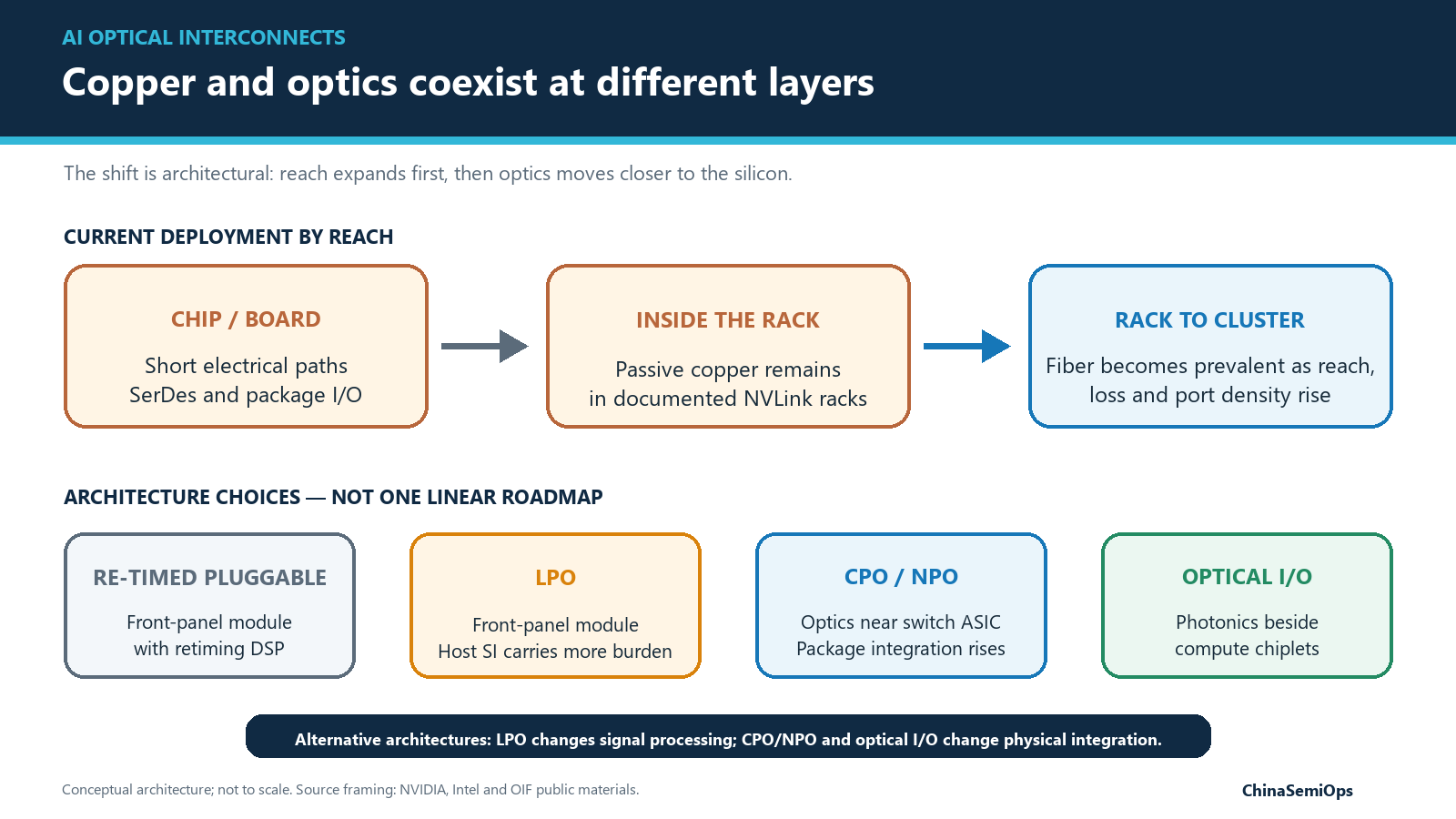
- Copper is still current technology. It remains efficient for the shortest electrical paths and is used inside documented NVIDIA NVLink racks.
- Optics enters first where reach and density rise. Rack-to-rack and cluster links face the hardest electrical-loss constraints.
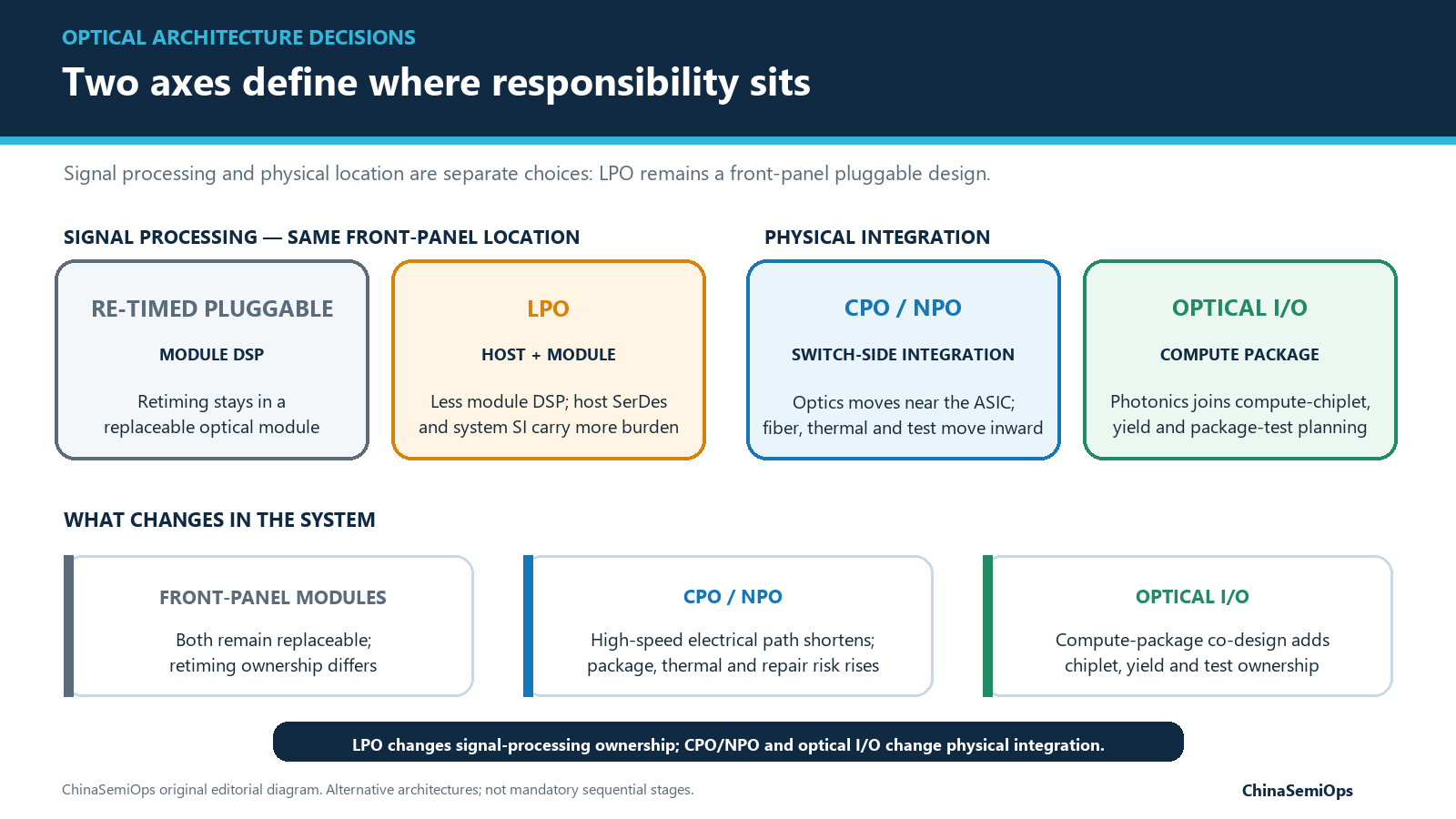
- Architecture changes ownership of risk. LPO shifts more signal-integrity burden to the host; CPO and optical I/O additionally shift packaging, thermal, test and service responsibilities.
Where Copper and Optics Fit
Passive copper is attractive over short distances because it can avoid optical conversion at each end. NVIDIA’s DGX GB rack hardware guide identifies a passive-copper cable-cartridge backplane for rack-scale NVLink connections.
The economics change as links move between racks and across clusters. Higher lane rates and longer paths increase insertion loss, equalization demands and cooling cost. Fiber supplies reach and bandwidth density without the same distance-dependent electrical penalty.
Four Architectures Solve Different Problems
| Architecture | What moves | System trade-off |
|---|---|---|
| Pluggable optics | A replaceable front-panel module contains much of the optical and signal-conditioning chain. | Modular and serviceable, but the ASIC still drives a demanding board channel. |
| LPO | Some module-level DSP functions are reduced or removed. | Lower power potential, with more burden on host SerDes and system signal integrity. |
| CPO | The optical engine moves beside the switch ASIC. | Shorter electrical paths, but harder packaging, cooling, fiber attach and field service. |
| Optical I/O | Photonics moves beside CPU, GPU or other compute chiplets. | Greater package-level integration, with demanding chiplet, thermal and test coordination. |
The Optical Internetworking Forum’s current work includes 224G linear interfaces for LPO, CPO and near-package optics. Intel also demonstrated an optical I/O chiplet with a prototype CPU. These are direction signals, not proof that every architecture has reached the same deployment stage.
Architecture Changes Who Owns the Risk
Signal processing and physical location are separate decisions. LPO remains a front-panel pluggable architecture but transfers more link margin to the host. CPO and optical I/O physically move optics toward switch or compute silicon, expanding package, thermal, test and repair responsibilities.
Five Questions Decide the Architecture
- How far must the signal travel? Short package and board paths favor electrical links; longer paths strengthen the case for fiber.
- What power is being removed? Shortening the electrical channel can reduce equalization and retiming, but lasers, control and thermal management remain.
- What must be field-replaceable? Pluggables isolate failures in a swappable module; tighter integration enlarges the failure and repair domain.
- Who owns signal integrity and packaging yield? LPO transfers more burden to the host link, while CPO and optical I/O demand deeper package co-design.
- What evidence exists at the required maturity? A prototype, early customer system and volume platform are not interchangeable proof points.
Evidence boundary: Architecture announcements establish technical direction. They do not, by themselves, establish broad deployment, qualification, manufacturing yield or independent performance.
Architecture Map, Not a Shipping Scorecard
This article answers where copper, pluggable optics, LPO, CPO and optical I/O fit in the system. For a product-maturity view—including what is shipping, what is sampling and where power-management ICs may participate—see our earlier analysis, Co-Packaged Optics and Its IC Supply Chain.
The Practical Conclusion
There is no single copper-to-optics switchover. Copper remains effective for short, dense electrical links; fiber becomes more valuable as reach and port density rise; and tighter optical integration is selected when its electrical benefits justify the packaging and service burden.
The useful question is not “When will optics replace copper?” It is “At which layer does optics create more system value than the integration risk it introduces?”
Disclaimer: This article is informational content based on public technical and corporate sources; it is not investment advice. Product maturity and performance should be verified against current vendor and customer evidence.
Selected Public Sources
- NVIDIA DGX GB rack hardware guide
- NVIDIA CPO ecosystem technical description
- Intel optical I/O chiplet demonstration
- TSMC COUPE roadmap
- OIF current technical work
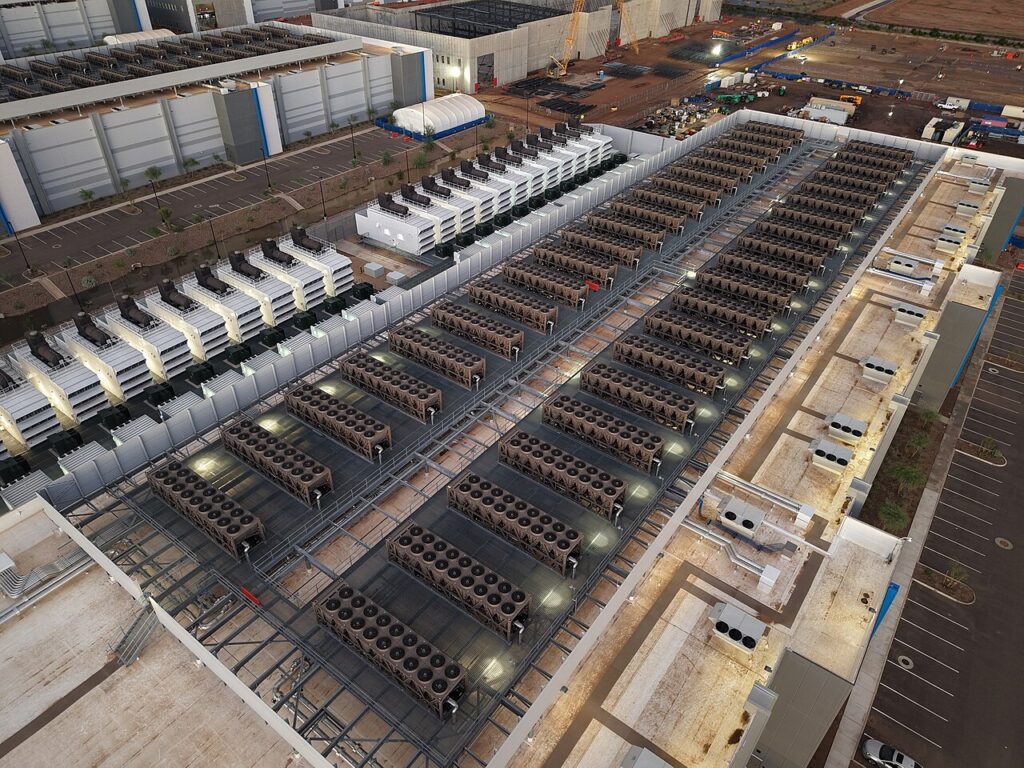
Featured image: “Data center roof” by Rsparks3, via Wikimedia Commons, dedicated to the public domain under CC0 1.0. Photographed November 23, 2025; Wikimedia-generated 1280px resize; no local visual edits. The photograph illustrates large-scale data-center infrastructure and does not depict a specific optical architecture or vendor platform. Inline diagrams are original ChinaSemiOps editorial graphics.