HVAC demand is becoming a semiconductor-content story, not only an equipment-volume story. The strongest openings sit where efficient systems convert power, control motors, measure operating conditions and protect people and equipment.
That puts compressor-inverter gate drivers, PFC, auxiliary power, sensing and control at the center of the near-term opportunity.
Three takeaways
- Main opportunity: inverter compressors, outdoor fans and power-factor correction pull gate drivers, power switches, controllers, sensing and protection.
- Supporting opportunity: indoor BLDC control, low-standby power, environmental sensing, valve drivers and connectivity broaden the semiconductor bill of materials.
- Product screen: prioritize repeatable HVAC loads where better silicon creates measurable gains in efficiency, acoustics, protection, integration or qualification effort.
Heat and electrification raise the value of efficient control
Confirmed: The World Meteorological Organization says 2025 was one of the three warmest years on record and that 2015–2025 were the eleven warmest years in its consolidated datasets. The International Energy Agency’s 2023 space-cooling analysis says cooling energy consumption would more than double by 2050 if no action is taken, while passive design, behavior and more efficient equipment can temper that growth.
Heating electrification adds another demand vector. Association market data: the European Heat Pump Association reports that 2025 sales rose 13% to 2.9 million units across 21 European countries, bringing the installed stock there to 29.3 million. These figures are regional, not a global forecast.
Inference: equipment shipments alone do not determine semiconductor revenue. The more useful indicator is the penetration of variable-speed compressors, electronically controlled fans and tighter sensing and protection.
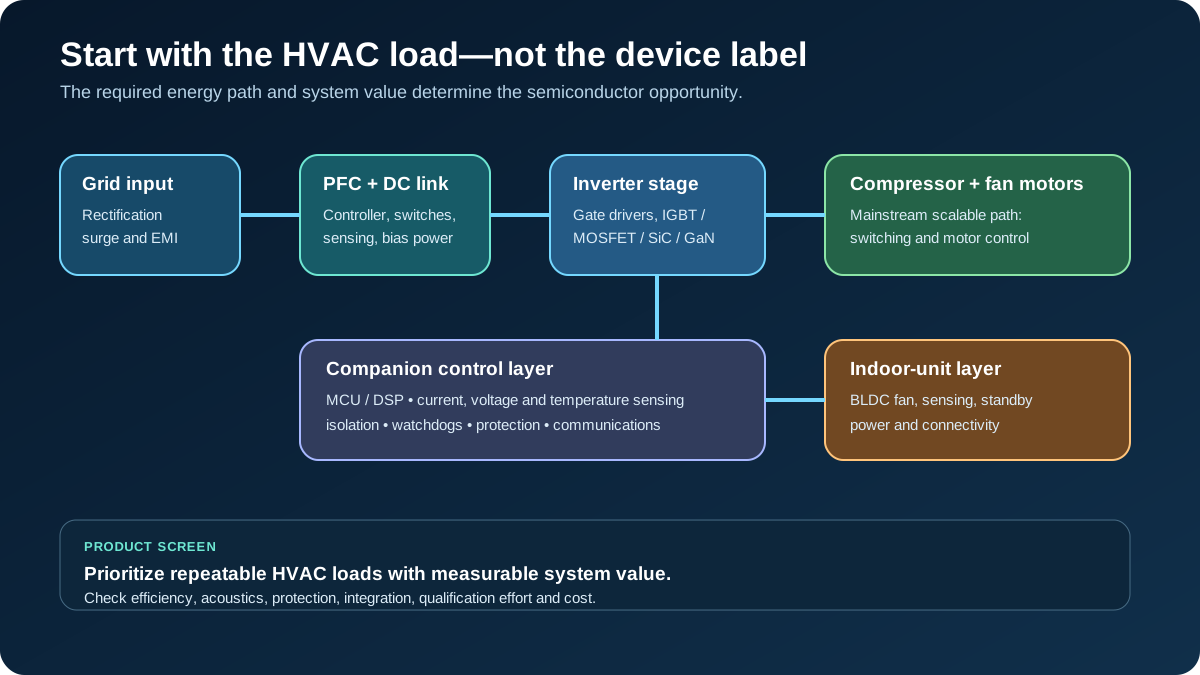
The outdoor unit is the semiconductor center of gravity
Vendor application evidence: Texas Instruments’ 1.5 kW HVAC reference design combines dual PMSM motor control for a compressor and fan with interleaved boost PFC. Its outdoor-unit design guidance also emphasizes PFC, compressor control, acoustics and sensing. This does not prove one supplier’s market share; it does show the functions a working variable-frequency outdoor controller must cover.
The gate-driver socket is therefore wider than a single IC. A credible platform may require:
- high-side/low-side or isolated gate drivers matched to the chosen IGBT, silicon MOSFET, SiC MOSFET or GaN switch;
- undervoltage lockout, desaturation or overcurrent response, Miller-clamp behavior and controlled turn-on/turn-off;
- a motor-control MCU or DSP, PWM generation and current reconstruction;
- PFC control, rectification and DC-link voltage sensing;
- shunt, Hall or isolated current sensing plus temperature monitoring;
- isolated communication or digital isolation where the architecture requires it;
- auxiliary flyback or bias supplies, DC/DC conversion and LDO rails; and
- fault logging, watchdogs, relay control and system-level protection.
Inference: the best entry product may not be a bare gate driver. An integrated driver-plus-protection function, a sensing companion, or an application-specific control IC can solve more of the OEM’s efficiency, acoustic-noise and fault-response problem.
For a related technology-screening method, see ChinaSemiOps’ GaN gate-driver opportunity analysis. The end market is different, but the same discipline applies: define the switching device, parasitics, protection and measurable system advantage before declaring an IC opportunity.
Indoor units create a broader, lower-power IC layer
The indoor unit moves less power but repeats across a large equipment base. BLDC fan control, low-standby AC/DC or DC/DC power, temperature and humidity measurement, local control, displays and wired or wireless links all create sockets. Stepper, solenoid or dedicated actuator drivers may control valves and dampers.
Standby efficiency, conducted and radiated emissions, surge tolerance, sensor drift, moisture, lifetime and cybersecurity can decide whether a seemingly simple controller is acceptable.
Open question: which functions should be integrated? A highly integrated indoor-unit controller can reduce board area and assembly cost, while a modular controller may serve more OEM platforms. The answer requires target-board BOMs, volume bands, required interfaces and field-failure data—not only a market forecast.
Specialized air treatment needs a separate safety screen
Electrostatic precipitators, ionizers and plasma air cleaners use high-voltage generation, sensing and fault control, but they should not be grouped with mainstream compressor and fan electronics. Their operating principle, emissions profile and qualification burden create a different product screen.
Before screening an air-treatment power IC, define output voltage and current, load capacitance, waveform, fault energy, isolation, emissions limits and the target certification path. Without those inputs, the topology and commercial opportunity remain unresolved.
Any air-treatment opportunity needs an adjacent safety gate. Confirmed: the U.S. EPA warns that some electrostatic precipitators, ionizers and plasma air cleaners can emit ozone. EPA also states that no federal agency has approved intentional ozone generators for occupied spaces. That means emissions, byproducts, applicable certification and occupied-space suitability must be established before treating an electrostatic or ionization socket as scalable.
A load-first decision table
| Load or function | Primary semiconductor need | Opportunity priority | Evidence status |
|---|---|---|---|
| Compressor and outdoor fan | Inverter gate driver, power switch, MCU/DSP, current sensing, protection | High | Confirmed architecture; priority is inference |
| PFC and auxiliary rails | PFC controller, switch/diode, isolated or non-isolated bias power, sensing | High | Confirmed architecture; priority is inference |
| Indoor BLDC fan | BLDC driver/control, low-voltage power, sensors | Medium-high | Vendor application evidence; priority is inference |
| Valve or damper | Stepper, solenoid or dedicated actuator driver | Selective | Engineering classification |
| ESP, ionizer or plasma air-treatment stage | HV generation, sensing and fault control; exact topology requires OEM load data | Conditional and safety-heavy | Air-treatment category and ozone risk confirmed by EPA; topology remains application-specific |
| Refrigerant and system safety | Sensing, isolation, diagnostics, MCU and power supervision | Selective and market-specific | Architecture opportunity; requirements are market-specific |
The practical product-screening sequence
Start with the load and required waveform, not with an attractive device category. Then quantify the operating voltage, current, switching or settling behavior, fault cases, temperature and lifetime. Finally, ask whether integration creates a measurable advantage in efficiency, acoustics, board area, protection, qualification effort or cost.
That sequence points first to gate drivers and their companion control, power, sensing and protection ICs. It also separates repeatable HVAC platforms from specialized air-treatment functions that require different safety and qualification evidence.
If you are screening a public-source, non-confidential HVAC IC concept, the next useful artifact is a one-page load-and-waveform specification. It will reveal quickly whether the opportunity is a gate driver, motor controller, power-supply IC, sensor interface or another dedicated function.
Primary references
- World Meteorological Organization — 2025 was one of the three warmest years on record
- International Energy Agency — Space cooling
- European Heat Pump Association — Market data
- Texas Instruments — 1.5 kW dual-motor HVAC control with interleaved PFC
- Texas Instruments — Air-conditioner outdoor-unit design resources
- U.S. EPA — Guide to Air Cleaners in the Home
- U.S. EPA — Ozone Generators that are Sold as Air Cleaners
Disclosure: This is a public-source market and application-screening analysis. Opportunity rankings are ChinaSemiOps inferences, not market-share forecasts. It does not state or imply customer programs, qualified HVAC products, field deployment or production readiness.