Choosing a piezo driver by voltage alone can put a design in the wrong product category. A 190 Vpk-pk haptic IC and a 350 V precision amplifier both drive capacitive actuators, but they solve different customer problems.
Portable haptics rewards energy recovery, waveform control and sensing. Nanopositioning rewards low noise, settling and capacitive-load stability. Inkjet and ultrasound add channel density, timing and thermal constraints. The useful market map therefore begins with the load—not a single “piezo driver IC” label.
Three takeaways
- Architecture first: load capacitance, waveform, frequency, current and channel count matter as much as voltage.
- Different value stacks: haptics integrates power conversion and sensing; precision positioning needs linear performance; ultrasound and inkjet need specialized arrays.
- Analog opportunity: a staged 80–350 V precision-amplifier family is credible, but each voltage class needs its own process, SOA, package and customer-load evidence.
One material creates four different IC businesses
A piezo actuator looks mainly capacitive to its driver. The first-order current relation is simple:
I = C × dV/dt
The product decision is not. A larger capacitance, faster edge or higher repetition rate increases current and dissipation. A static positioning command has different noise and settling requirements from a haptic pulse or an ultrasound burst.
For sinusoidal drive, peak output current scales as Ipk = 2πfCVpk, where Vpk is the single-sided peak voltage. Many piezo datasheets quote Vpk-pk; for a symmetric bipolar waveform, Vpk = Vpk-pk / 2. Frequency and capacitance can therefore raise current demand much faster than the headline voltage class suggests.
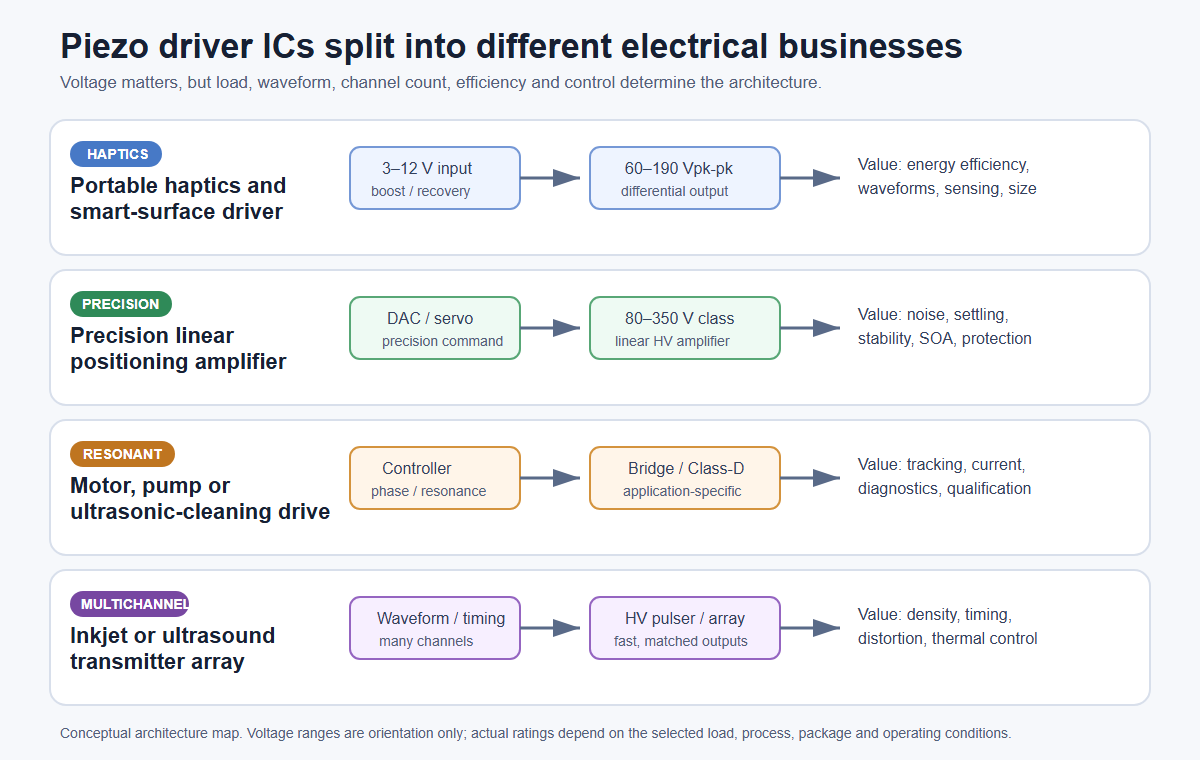
This separation also explains why supplier portfolios should not be treated as a simple market-share table. Products that all mention “piezo” may not compete for the same socket.
Haptics turns the driver into a mixed-signal platform
Confirmed product evidence: Boreas’s active BOS1921 combines a 190 Vpk-pk differential output with energy recovery, sensing, waveform synthesis and I3C/I2C control. Its BOS0614 drives four 60 V channels and adds zero-power sensing for solid-state button applications.
TI’s active DRV2667 combines a 105 V boost stage, differential amplifier, waveform memory and digital front end. Analog Devices’ MAX77501 uses a digital waveform engine and external high-voltage FETs for battery-powered haptics. Microchip publishes several further architectures, including dual high-voltage amplifiers and a 16-channel surface-haptics driver.
ChinaSemiOps inference: in haptics, an HV output stage alone is unlikely to be enough. Power efficiency, sensing, actuator tuning, mechanical integration, firmware, package size and qualification form much of the competitive value.
TDK’s PowerHap actuator portfolio reinforces the ecosystem point: actuator classes, mechanics and driver settings are designed together for displays, buttons, VR and industrial interfaces.
Precision positioning is the natural HV-amplifier lane
Precision positioning serves a different system. Semiconductor inspection, photonics alignment, microscopy, optical focus and scientific equipment may need accurate quasi-static movement or fast settling rather than a rich haptic effect.
Confirmed product evidence: Apex’s PA441/PA443 are 350 V low-noise power amplifiers explicitly positioned for piezoelectric positioning. The single-channel PA441 is specified for 60 mA continuous and 120 mA peak output. Analog Devices’ ADHV4702-1 is a 220 V precision op amp with piezotransducers among its applications.
PI’s public wafer-inspection and metrology demonstrator shows why the end system values repeatability, stability and settling—not voltage in isolation.
ChinaSemiOps inference: this is the most direct high-voltage analog opportunity. A product family can span approximately 80–120 V, 160–220 V and 300–350 V classes, provided each product has a declared capacitive-load map, linear SOA, compensation strategy, current limiting, thermal behavior and suitable package.
Evidence that a first product can source or sink useful current around 120 V must not be treated as proof for 160–220 V or 300–350 V products. Each higher-voltage lane needs separate process, package, SOA, protection, thermal, reliability and production-test validation.
The lower range may be a practical first implementation. It should not become a permanent voltage ceiling. Our earlier guide to SOI, BCD and high-voltage analog process selection explains why each voltage lane requires a separate process and isolation decision.
Motors, pumps and cleaning favor controller-plus-power solutions
Piezo motors, micropumps and ultrasonic cleaning can require resonant, multiphase or burst drive. Here, the waveform and mechanical system may determine the silicon partition.
Confirmed product evidence: TI’s automotive DRV2911-Q1 integrates bridge outputs for piezo-based ultrasonic lens-cleaning systems and is demonstrated with a separate ULC1001 controller. Nisshinbo’s ND1130 combines a boost converter with dual H-bridges for small piezo actuators.
Open question: can one catalog IC serve several motors or pumps? Often the useful entry is customer-led: obtain the actuator impedance, phase sequence, resonance range, waveform, startup behavior and fault cases before choosing the bridge, boost stage and controller boundary.
Inkjet and ultrasound are real but application-heavy
Microchip’s piezoelectric printhead portfolio describes 50–200 V actuation and open-drain, push-pull and operational-amplifier approaches. Its medical-ultrasound portfolio includes high-voltage transmitters, switches, FET arrays, arbitrary-waveform generators and T/R functions.
ABLIC similarly publishes digital and linear ultrasound transmitters, including linear arbitrary-waveform products for high-end systems.
A multichannel inkjet or ultrasound transmitter is not merely a scaled-up single-channel precision amplifier. Channel matching, routing, synchronized timing, package parasitics, thermal density and production test make it a different product program.
These are established semiconductor categories, but they are poor first products for a small team without an anchor customer. Channel matching, peak current, timing, distortion, package parasitics, thermal design, production test and application support create a much larger program than a single precision amplifier.
For the printing branch, our earlier 3D printing and power-analog analysis gives the wider equipment context. Electrostatic MEMS should remain separate; our OCS MEMS driver guide explains that neighboring architecture.
A practical market and product screen
| Application | IC value that matters most | Public portfolio anchors | Opportunity screen |
|---|---|---|---|
| Portable and PC haptics | Energy efficiency, waveforms, sensing, small size | Boreas, TI, ADI/Maxim | Attractive market story; difficult platform and ecosystem competition |
| Automotive haptics | Qualification, diagnostics, force sensing, actuator power | Boreas, Microchip, regional specialists | Attractive when paired with actuator and Tier-1 requirements |
| Precision positioning | Noise, drift, settling, capacitive stability, SOA | Apex, ADI | Strongest fit for a staged 80–350 V HV-amplifier family |
| Motors, pumps and ultrasonic cleaning | Resonance/phase control, bridge efficiency, protection | TI, ADI, Nisshinbo | Best as an application-specific or customer-led product |
| Industrial inkjet | Waveform accuracy, peak current, channel density, thermal design | Microchip, Apex | Real but application-support intensive |
| Medical ultrasound and NDT | Fast matched pulsers, HV switching, T/R protection, many channels | Microchip, TI, ABLIC | Established and demanding; anchor customer needed |
This table ranks architecture fit, not supplier market share. Public product pages do not establish shipment volumes, design wins or a clean standalone piezo-driver IC TAM.
Start with a one-page load specification
Before choosing an IC concept, record the actuator capacitance and loss, output swing and polarity, waveform, frequency, slew or settling target, peak and average current, duty cycle, temperature, cable, fault cases and required channel count.
Then ask what creates measurable customer value: lower power, lower noise, faster settling, more channels, better sensing, smaller size, safer faults or easier qualification.
That exercise will quickly reveal whether the opportunity is a precision HV amplifier, an energy-recovery haptic platform, a resonant bridge/controller or a multichannel pulser array. Piezo is the common material; the market opportunity is defined by the complete electrical and mechanical problem.
Primary references
- Boreas — BOS1921 piezo driver
- Texas Instruments — DRV2667 piezo haptic driver
- Analog Devices — MAX77501 haptic driver
- Apex Microtechnology — PA441/PA443 product bulletin
- Analog Devices — ADHV4702-1 precision HV amplifier
- Microchip — MEMS and piezoelectric drive solutions
- Texas Instruments — DRV2911-Q1 ultrasonic-cleaning driver
- TDK — PowerHap piezoelectric actuators
Disclosure: This is a public-source architecture and opportunity analysis. Product specifications remain subject to each manufacturer’s current datasheet and operating conditions. Opportunity rankings are ChinaSemiOps inferences, not market-share or shipment forecasts, and do not imply customer programs or production readiness.