A company developing driver ICs (integrated circuits, the control chips), or a lighting business planning an AC (alternating current) direct-drive LED (light-emitting diode) module in China, has one question to settle before anyone writes a quote: are you selling a chip into someone else’s design, or commissioning a finished, tested module?
An AC-direct LED module is an LED (light-emitting diode, the light source) board whose driver electronics, built around an IC (integrated circuit, a control chip), sit on the board itself and run directly from AC (alternating current) mains, the public electricity supply, without a separate power-supply unit. It is one lighting architecture among several.
Selling a driver IC into a Chinese lighting design is one route. Commissioning an assembled and tested module in China is another. They involve different counterparts, documents and acceptance evidence, and a request that mixes them is hard to quote.
One design choice runs through both routes: isolation. An isolated module has an electrical barrier between the mains and the LED side. A non-isolated module has no such barrier, so the LED side is electrically connected to the mains. Either way, the luminaire (the finished light fitting) must still provide the insulation its application needs.
This guide is an editorial recommendation. The handoff criteria below are suggestions for what to agree. They apply to any contract manufacturer, not only in China, and they are not reports of what any Chinese factory does.
Key takeaways
- Decide the route first: design-in support for a driver IC, or commissioned manufacture of a complete module.
- Define the whole module and its acceptance conditions before comparing quotations.
- Keep the IC, the module and the finished luminaire separate; safety, performance and market destination are product-specific.
Choose the commercial route first
IC design-in means a lighting designer chooses your chip for its own product. The counterpart is that designer’s engineering team, and the useful output is application support: a reference circuit, design notes and evidence from a comparable board.
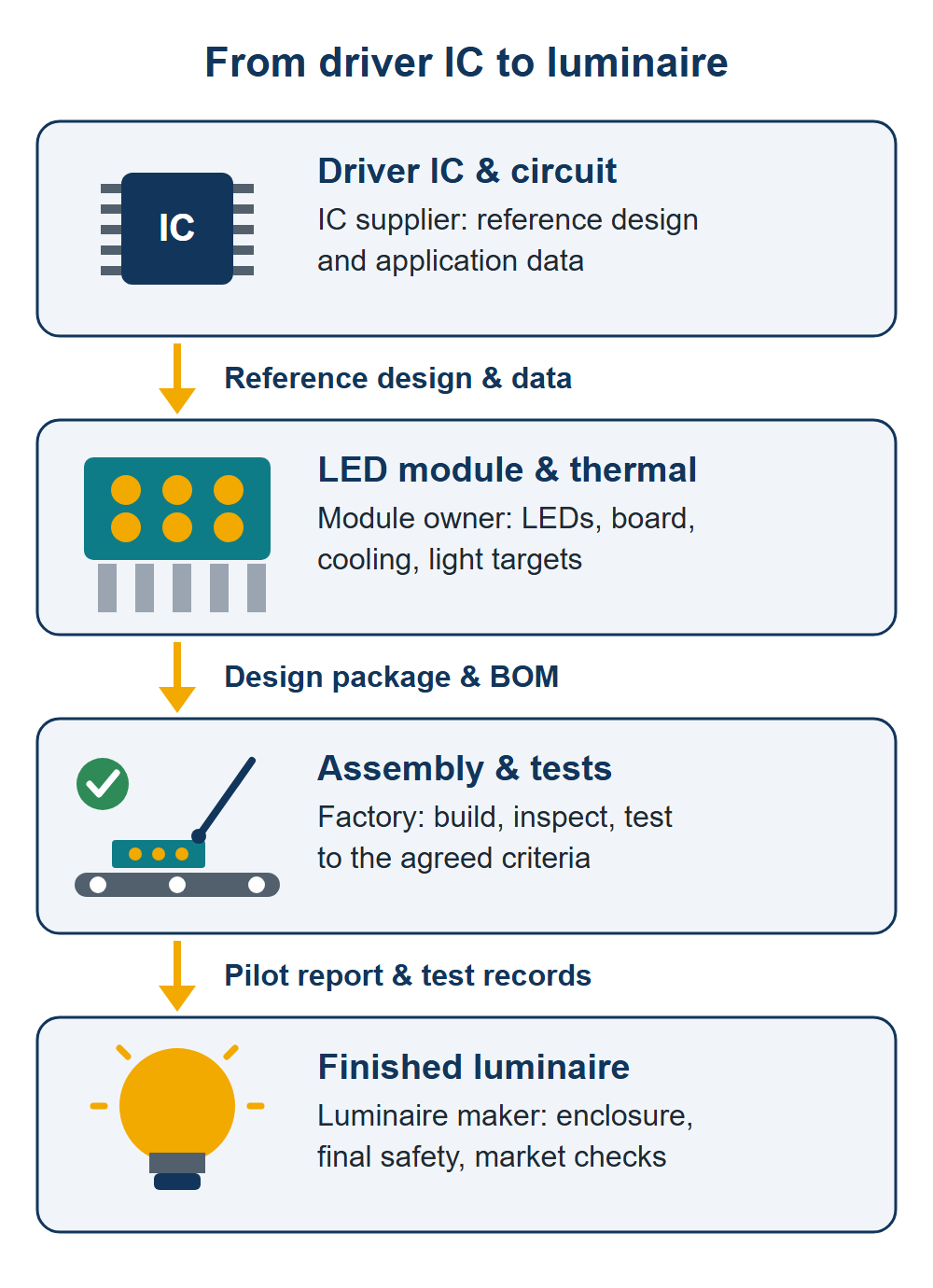
Commissioned module manufacture means a factory builds a complete module to your specification. The counterparts are engineering, purchasing and manufacturing, and the useful output is an agreed design package, a pilot build and production acceptance.
China’s lighting industry has counterparts for both. In an announcement dated 26 October 2026, Messe Frankfurt, organizer of the Guangzhou International Lighting Exhibition (GILE), describes a planned upstream exhibition area for its 2027 edition covering LED drivers, power supplies, integrated circuits and controllers, as well as packaged modules, production equipment and testing systems. That shows the range of roles in the value chain. It does not show any company’s capacity, qualification or availability for contract work.
Define the module before asking for a quote
A quotation request is only as clear as the module description. Write down:
- the application and the intended sales destination;
- the input voltage range and frequency;
- the output power and LED string configuration (a string is a group of LEDs wired together);
- the isolated or non-isolated approach, and the insulation the finished luminaire must provide;
- the PCB (printed circuit board) size and substrate, and the cooling arrangement;
- the light output, colour and dimming interface;
- flicker expectations (flicker is brightness variation over time);
- the ambient temperature range; and
- the allowed components, in a BOM.
Then say who owns each decision: circuit, LED selection, thermal design, board assembly, testing and final luminaire integration. If the answer is “the factory” for every item, you are commissioning a design as well as a build, and the quotation should reflect that.
Match the manufacturer to the work
Three kinds of business are easy to confuse: an LED-module producer, a lighting-product design and manufacturing business, and a board assembler. Each may do part of the job well.
SMT (surface-mount technology), which places components directly onto the board surface, is one capability. Light output, flicker, thermal behaviour and electrical safety each need their own test evidence.
Ask for engineering and test evidence on comparable work: what is measured, with what equipment, and how failures are fed back to design. An exhibition listing shows that a company took part; it does not qualify it. This applies to any contract manufacturer, not only in China.
Turn a reference design into a pilot build
Texas Instruments (TI) publishes TIDA-01399, a single-board reference design that TI describes as a 120 V AC LED driver. In TI’s description it is offline (powered directly from the mains; the word does not mean disconnected from a network), non-isolated (no electrical barrier between the mains and the LED side) and free of magnetics (no inductors or transformers). Its design guide is Revision A, dated 23 August 2017, so it is a foundational reference rather than market news. The package includes a schematic, BOM, board layout and assembly drawing, and TI states that the assembled board is for validation and is not offered for sale.
It is useful here for two reasons: it illustrates one AC-direct architecture, and it shows the gap between a reference design and a production handoff. It is specified for 120 V AC input; a module for a different mains voltage needs its own design and evaluation. Its measured results do not transfer to a different design.
Before a pilot build, agree the items below. They are proposed handoff criteria that apply to any contract manufacturer, with no numerical thresholds; set those from your own product requirements.
| Handoff item | Agree in writing | Evidence to request |
|---|---|---|
| Design ownership | Who owns the circuit, layout and manufacturing files | Versioned design package |
| Components | Approved BOM and allowed substitutions | Part-change procedure |
| LED selection | LED bin (sorting grade for brightness, colour and forward voltage, the voltage an LED needs when lit) controls | Incoming-lot records |
| Assembly | Assembly conditions and traceability | Lot and serial records |
| Testing | Which party tests what, and where | Test plan and equipment list |
| Pilot acceptance | Pass and fail rules, and failure feedback | Pilot report and failure analysis |
Because a non-isolated board has no barrier between the mains and the LED side, plan handling and testing with qualified safety engineers, and do not improvise energized tests.
Separate product classification from destination
A driver IC is not a module, and a module is not a finished luminaire. Each is classified and evidenced separately. The same goes for control gear (driver electronics that power LED modules or LED lamps, which are replaceable light sources) and for the finished luminaire. In an AC-direct module the driver electronics sit on the module, so confirm how your specific product is classified rather than assuming.
Where a product is made and where it is sold are also separate questions. Making a module in China does not settle whether it may be sold in China or anywhere else.
Safety, performance and EMC (electromagnetic compatibility, meaning limited radio-frequency noise and tolerance of interference) are different kinds of evidence. Two public sources show why the distinction matters:
- The IEC (International Electrotechnical Commission) published edition 3.0 of its LED-module safety standard on 23 February 2026, replacing the 2018 edition. Its public scope concerns the safety of LED modules, leaves their performance characteristics out, and excludes categories such as LED lamps. Only the public scope was reviewed, not the paid standard.
- CQC (China Quality Certification Centre) issued a notice dated 10 April 2025 revising its performance certification rule for general-lighting LED modules. Certification under the revised rule applies from 1 June 2025, with transition requirements for existing certificate holders. This describes a dated notice; it does not say that this is the latest rule today.
Neither source establishes a blanket certification requirement or shows that any particular module complies. The dates above are as read on 6 November 2026, and later changes were not checked. Confirm the current scope for your own product and destination before drawing a compliance conclusion.
The next step is one page that names the route, the module definition, the owner of each stage and the pilot acceptance conditions. Use it to compare counterparts, rather than comparing quotations that cover different scopes.
References
- Messe Frankfurt, GILE announcement, 26 October 2026: the range of upstream lighting roles the organizer plans to show.
- Texas Instruments, TIDA-01399 reference design: one non-isolated AC-direct architecture and its design files (design guide Rev. A, 2017).
- IEC, LED-module safety standard, edition 3.0 (2026), publication page: LED-module safety scope and its exclusion of performance requirements.
- CQC, notice of 10 April 2025: revised LED-module performance certification rule.
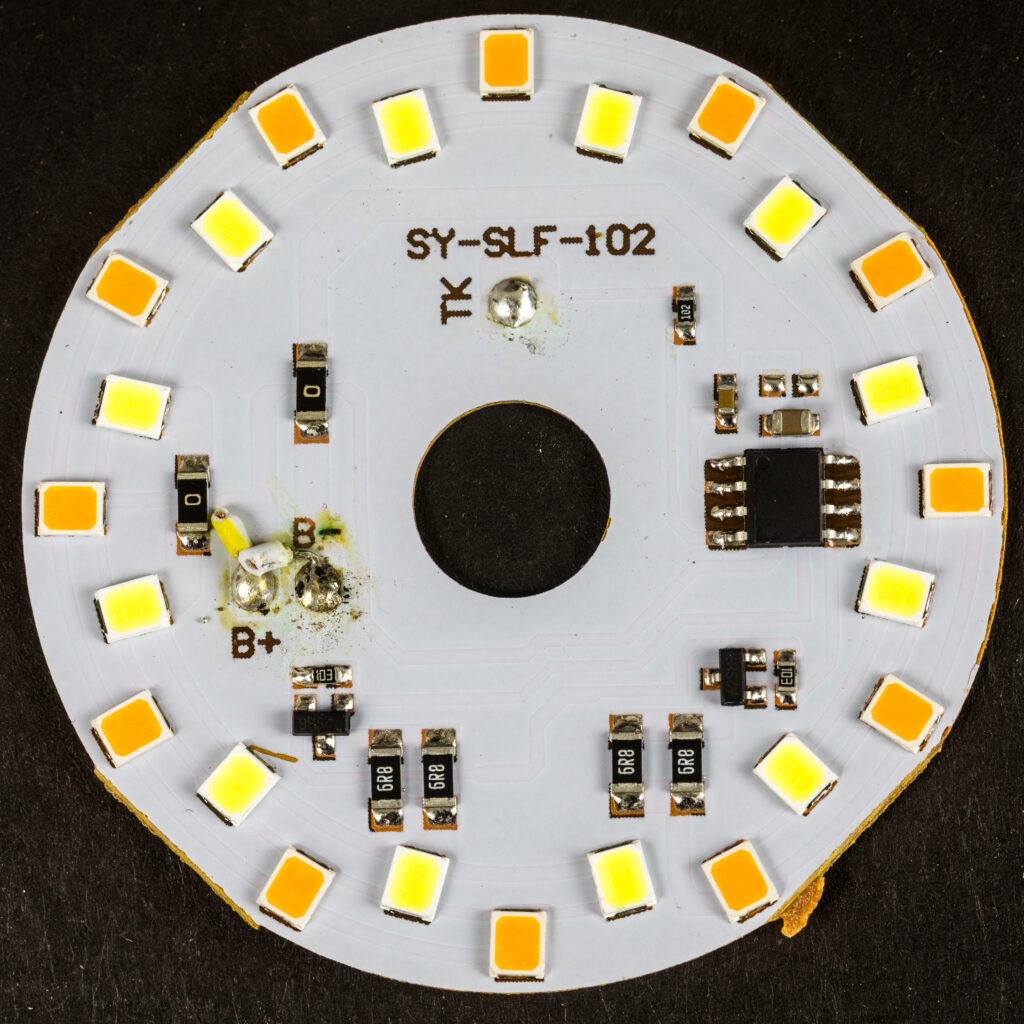
Featured photo: battery-powered desk-lamp LED board, shown only as a generic illustration; it does not establish an AC-direct design or production in China. © Raimond Spekking / CC BY-SA 4.0 (via Wikimedia Commons). Source | License. CC BY-SA 4.0 is the Creative Commons Attribution-ShareAlike 4.0 license: reuse requires credit, and adapted versions must carry the same license. The display may be cropped; any adaptation remains under CC BY-SA 4.0. The photo has its own license, separate from the republication notice below.
Please link to this article when sharing. Contact us for permission to republish the full article.