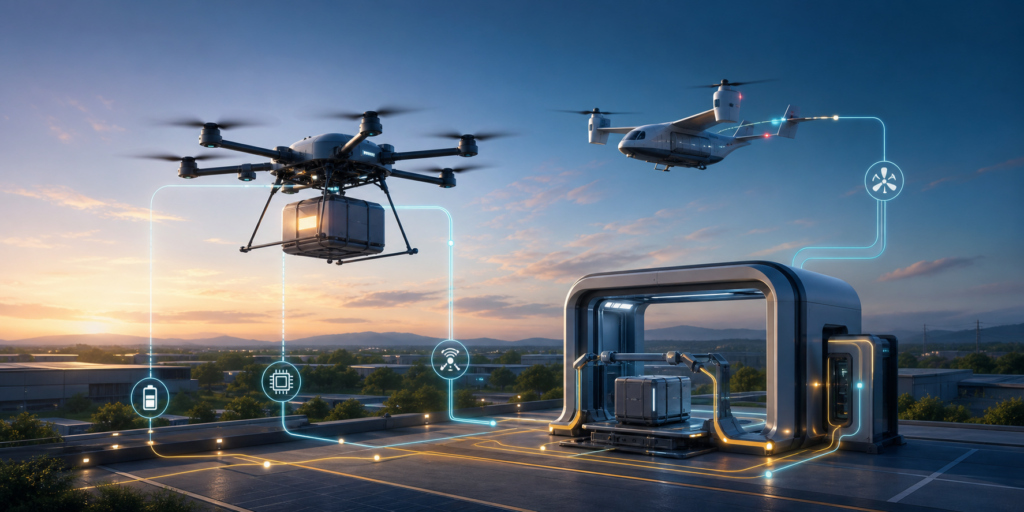
The low-altitude economy is often discussed as if it were another name for passenger eVTOL. That framing is too narrow. The emerging ecosystem also includes industrial and logistics drones, cargo aircraft, charging and battery-swap infrastructure, communications and navigation services, flight operations, testing, and conventional general aviation.
For power-analog semiconductor suppliers, that distinction matters. Passenger air taxis may attract the headlines, but nearer-term design opportunities can appear in less glamorous functions: protected power distribution, battery interfaces, payload power, automated docks, chargers, thermal systems, actuation, and diagnostic telemetry.
Key Insights
- China’s low-altitude economy is a broad industrial and service category. eVTOL is one aircraft configuration inside it, not the whole market.
- Industrial UAVs, cargo aircraft, docks, chargers, and ground infrastructure can create earlier semiconductor opportunities than passenger eVTOL.
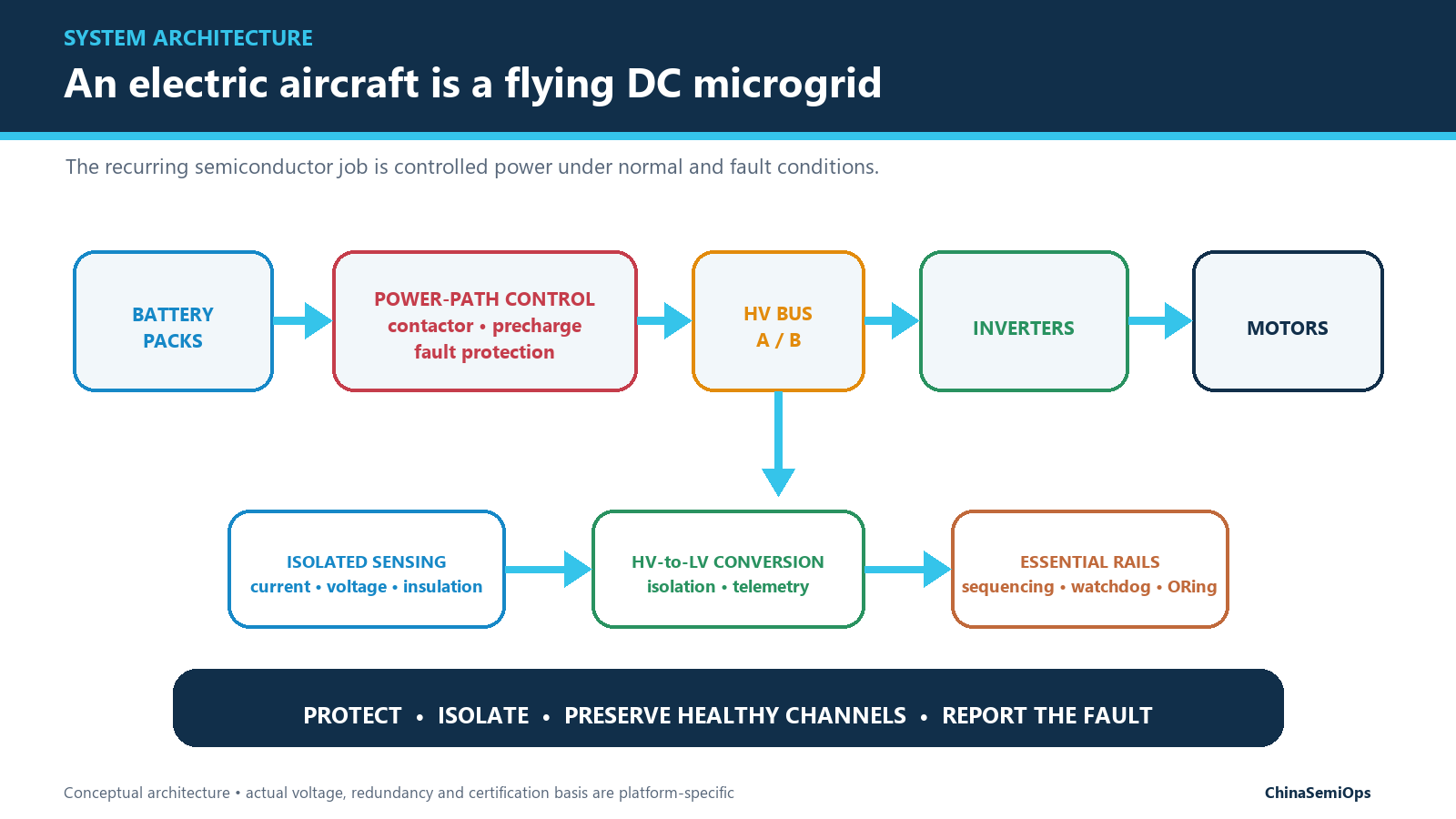
- An electric aircraft behaves like a safety-critical DC microgrid, creating repeated needs for protection, sensing, isolation, conversion, sequencing, and diagnostics.
- There is no single public eVTOL bus-voltage standard. Semiconductor requirements must be tied to a specific aircraft, subsystem, and mission.
- Automotive qualification can be useful evidence, but it does not by itself make an IC suitable or approved for civil-aircraft use.
Low-Altitude Economy, AAM, UAM and eVTOL Are Not Synonyms
Advanced Air Mobility, or AAM, describes an ecosystem of advanced aircraft, operations, airspace, infrastructure, and community integration. Urban Air Mobility is its urban and suburban subset. eVTOL describes an electric vertical-takeoff-and-landing aircraft configuration used in some AAM missions.
China’s low-altitude-economy framework is broader still. The National Development and Reform Commission’s trial statistical classification covers four major sectors: manufacturing, flight operations, infrastructure and information services, and supporting services. It explicitly includes motors, batteries, flight-control products, integrated circuits, sensors, communications, navigation, and surveillance equipment. (NDRC interpretation; classification PDF)
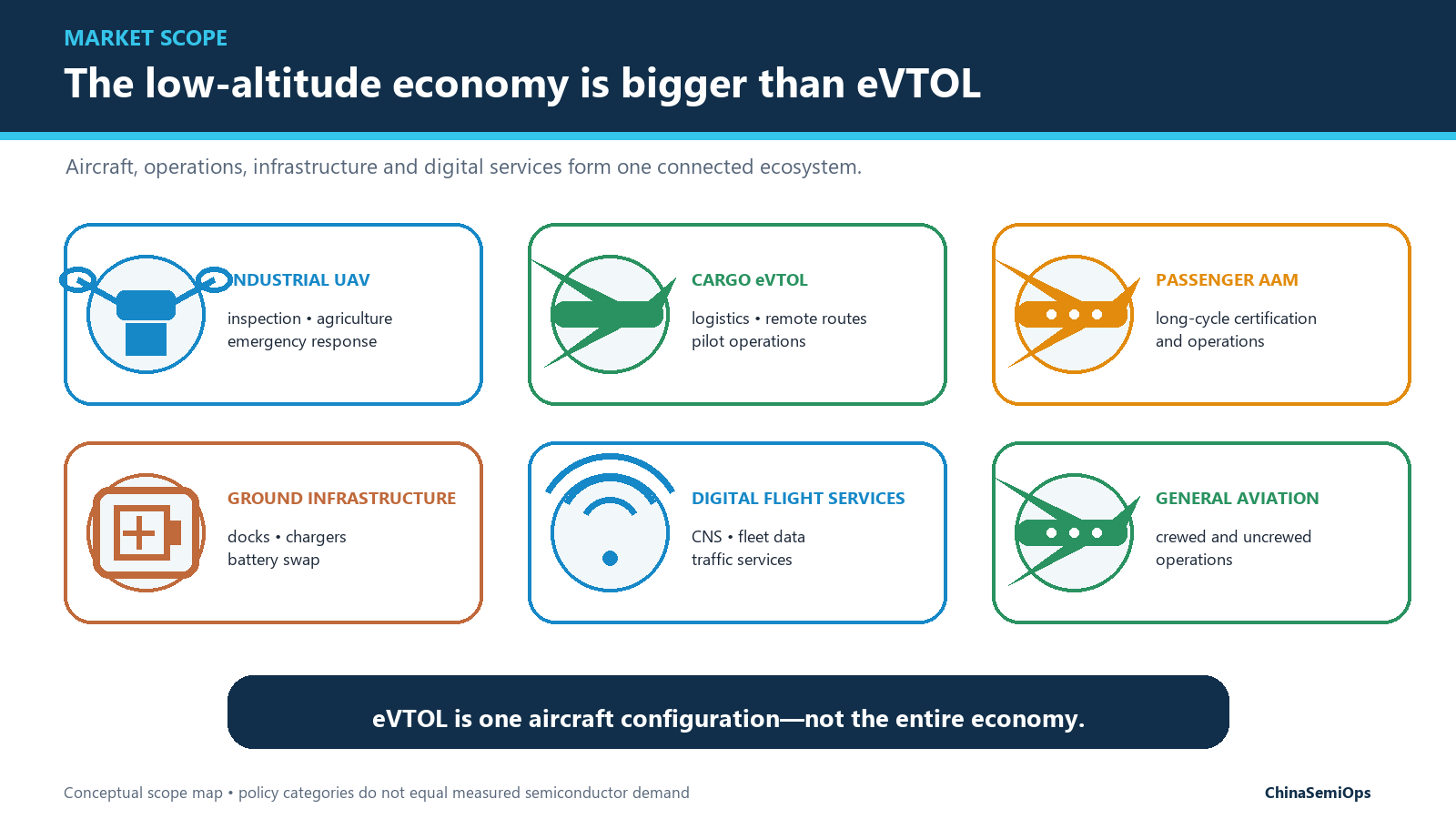
This definition makes the semiconductor opportunity larger than the aircraft alone, but it should not be mistaken for measured demand. A policy category identifies what belongs in the ecosystem; it does not reveal accessible unit volumes, supplier share, profitability, or procurement timing. Large market forecasts should therefore be treated as scenarios or policy targets rather than settled semiconductor revenue.
The Near-Term Market Is Broader Than Passenger Air Taxis
China already has product-specific certification precedents. AutoFlight’s V2000CG uncrewed cargo eVTOL received a CAAC type certificate in 2024, while EHang’s EH216-S received a CAAC production certificate. These are meaningful milestones, but they do not establish a universal route for other aircraft or guarantee large production volumes. (CAAC V2000CG record; CAAC EH216-S production record)
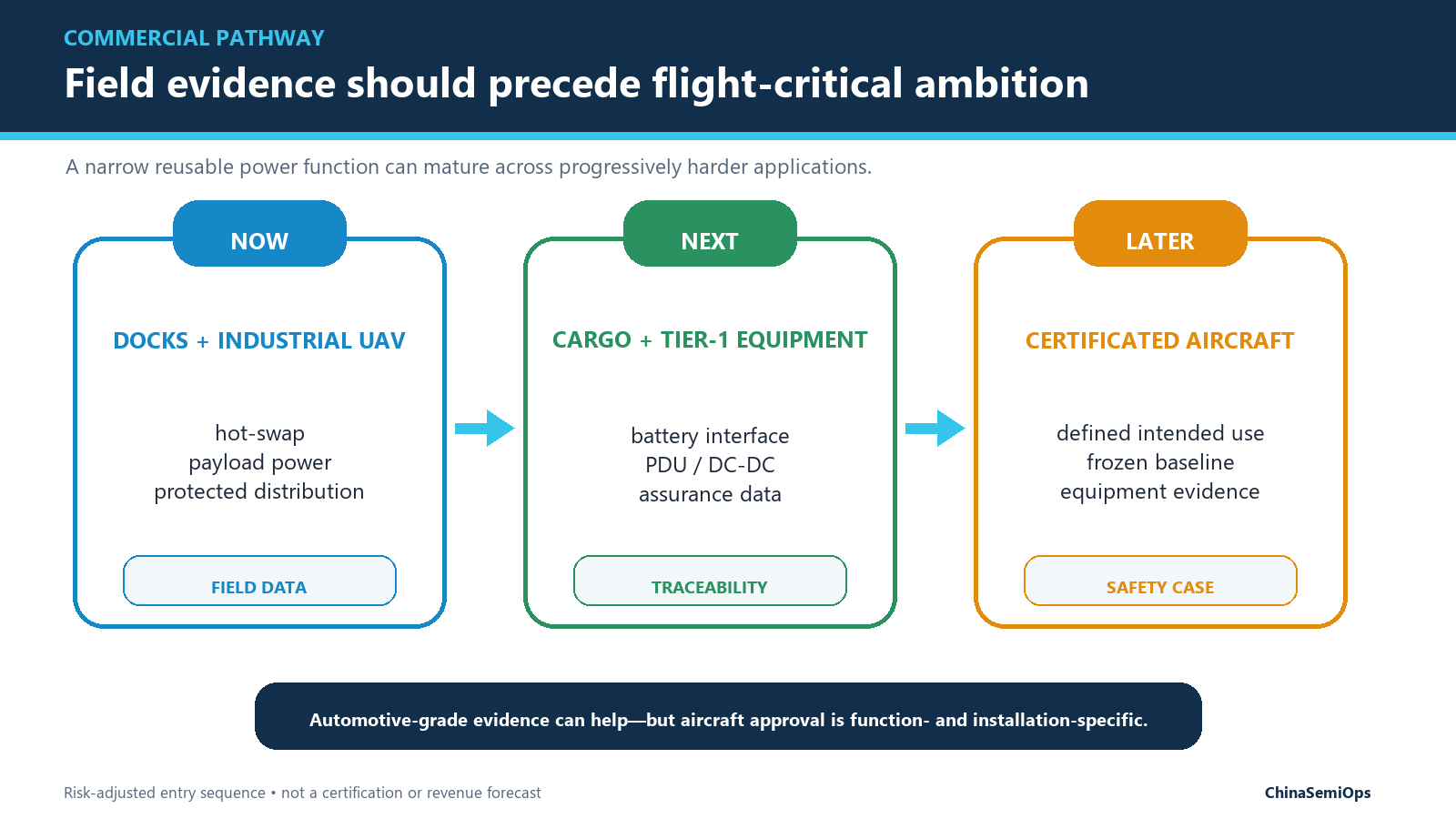
The more useful commercial sequence is to separate industrial UAVs, cargo eVTOL, and passenger eVTOL. They have different certification burdens, operating environments, volumes, price structures, and development cycles. Industrial and logistics systems can provide field experience and revenue while passenger-aircraft architectures and certification baselines continue to mature.
An Electric Aircraft Is a Flying DC Microgrid
A battery-electric aircraft must distribute high power while containing faults and preserving essential functions. Multiple battery packs may feed separated buses and independent propulsion channels. Contactors, precharge circuits, current and voltage sensing, insulation monitoring, inverters, isolated auxiliary conversion, and redundant low-voltage rails all participate in the safety architecture.
Public architectures differ substantially. Joby describes multiple batteries and independent drive units, while Archer describes six independent battery packs and twelve engines. NASA’s experimental X-57 used a 460 VDC traction battery, and Vertical Aerospace reported up to 1.4 MW peak pack output for a prototype. These examples demonstrate the range of the problem; they do not establish one universal eVTOL voltage or power level.
Where Power-Analog ICs Fit
| Subsystem | Power-analog functions | Engineering priority |
|---|---|---|
| Battery and pack interface | Monitoring, isolated communication, contactor and precharge control, independent protection | Accuracy, diagnostics, fault containment |
| Propulsion inverter | Isolated gate drive and bias, DESAT, soft shutdown, current and voltage sensing | High dV/dt immunity, timing, safe shutdown |
| HV distribution | Breaker and eFuse control, pyrofuse or contactor drive, insulation and arc-fault monitoring | Fast interruption and selective isolation |
| Auxiliary conversion | Isolated HV-to-LV control, redundant ORing, telemetry | Essential-rail availability without common-cause loss |
| Low-voltage rails | Bucks, LDOs, supervisors, sequencers, watchdogs, ideal diodes | Deterministic startup and latent-fault detection |
| Actuation and thermal | Motor drivers, current interfaces, pump, fan, and heater control | Compact, diagnosable control |
| Docks and chargers | Hot-swap, metering, surge protection, power-path control | Autonomous uptime and remote diagnostics |
The repeated pattern is not simply higher voltage. It is controlled power under faults. The valuable functions are often the ones that detect abnormal behavior, isolate the affected branch, preserve healthy channels, and report enough information for maintenance or flight-control decisions.
A Practical Entry Point Is a Narrow, Reusable Power Function
For a smaller fabless supplier, attempting to enter with a complete battery-management platform, flight-computer PMIC, or main SiC propulsion module creates a large development and assurance burden against established competitors. A narrower power-path, protection, telemetry, or diagnostic function can be more realistic.
One example is a smart external-MOSFET power-path or eFuse controller for 24 V, 48 V, or 60 V-class subsystems. In industrial UAVs, payload power, docks, battery-swap stations, and charging cabinets, such a device can combine inrush control, reverse-current blocking, fast short-circuit cutoff, voltage and current telemetry, thermal protection, and a hardwired fault output. The same architectural base can later support more controlled aerospace programs if the intended function, process margin, evidence package, and equipment partner justify it.
This is a product-development hypothesis, not a claim that one voltage range or topology fits every platform. Customer discovery must establish the real transient envelope, MOSFET choice, fault response, telemetry accuracy, redundancy, environmental limits, and software-independence requirements before specification freeze.
The Certification Moat Is Evidence, Not a Logo
An IC is not made aviation-ready merely by attaching an automotive qualification label. AEC-Q100 and automotive safety collateral can be useful inputs, but civil-aircraft approval is assessed at the installed-function and equipment level. Intended use, failure conditions, common-cause risk, environmental exposure, configuration control, errata, lifecycle, and manufacturing changes all matter.
FAA guidance for complex commercial-off-the-shelf devices highlights the need for configuration, maturity, errata, failure-mode, and intended-use evidence. For a semiconductor supplier, this translates into practical capabilities: frozen ordering baselines, lot traceability, transparent PCN and errata processes, retained samples, failure-analysis support, diagnostic documentation, and long-term supply discipline. (FAA AC 20-152A)
The credible route into certificated aircraft therefore usually runs through an equipment supplier:
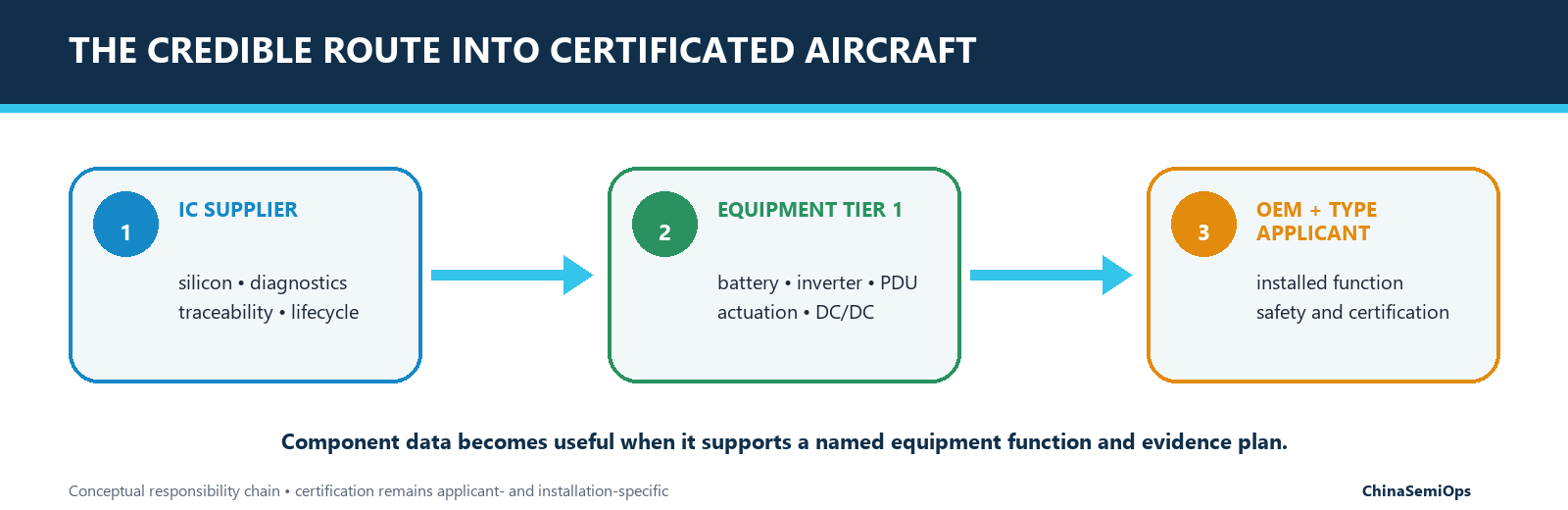
This route allows component evidence to be developed against a defined installed function instead of claiming that a standalone IC is “aviation certified.”
What Buyers and Design Partners Should Ask
- Which aircraft or ground subsystem is the device intended to protect or power?
- What are the nominal, maximum, transient, and fault voltages at the IC pins?
- Can protection operate autonomously if software or communication fails?
- Which faults must be isolated, and which healthy functions must remain available?
- What diagnostic coverage and fault reporting does the equipment safety analysis require?
- How will configuration, errata, PCNs, lot traceability, and long-term supply be controlled?
- Is the first target an industrial UAV, cargo aircraft, passenger aircraft, or ground installation?
- Who owns equipment-level environmental, EMC, fault-injection, and certification evidence?
Closing View
The low-altitude economy should not be reduced to a passenger-eVTOL forecast. Its nearer-term semiconductor content spans industrial drones, cargo systems, protected power distribution, batteries, payloads, charging, automated docks, actuation, and infrastructure.
For power-analog suppliers, the strongest entry strategy is to own a repeatable power function with measurable fault behavior and useful telemetry, prove it in operating industrial systems, and build the traceability and change-control evidence required for more demanding aerospace programs. The opportunity is not simply to “sell a chip into eVTOL.” It is to make electrical power more controllable, diagnosable, and resilient across the wider low-altitude ecosystem.
Selected Public Sources
- NDRC interpretation of China’s low-altitude-economy statistical classification
- China’s 2024–2030 general-aviation equipment development plan
- EASA air-mobility terminology
- EASA small-category VCA rules
- NASA/RTX high-voltage DC breaker research
- ADI eVTOL battery-management and power overview
- Honeywell–NXP aviation technology partnership
Note: This article is an industry and engineering framework, not a market-size forecast, aircraft-certification opinion, or recommendation for a specific IC, foundry, platform, or design program.